
Technology & Safety Standards Breakdown, Post
Demystifying the Latest European ECE R22.06 Safety Standard on Modern HJC Helmets
May
HJC In the global motorcycle industry, safety certifications are the absolute boundaries that dictate the engineering of life-saving protective gear. For nearly two decades, the Economic Commission for Europe’s ECE 22.05 protocol reigned supreme as the gold standard for road-legal motorcycle helmets across more than 50 countries, heavily influencing regional safety frameworks, including Vietnam’s strict Quatest evaluations. However, as motorcycle engine performance skyrocketed and medical science advanced our understanding of traumatic brain injuries, the old framework revealed critical blind spots.
In response to modern riding realities, regulatory bodies officially introduced a comprehensive, radically upgraded safety mandate: the ECE R22.06 standard.
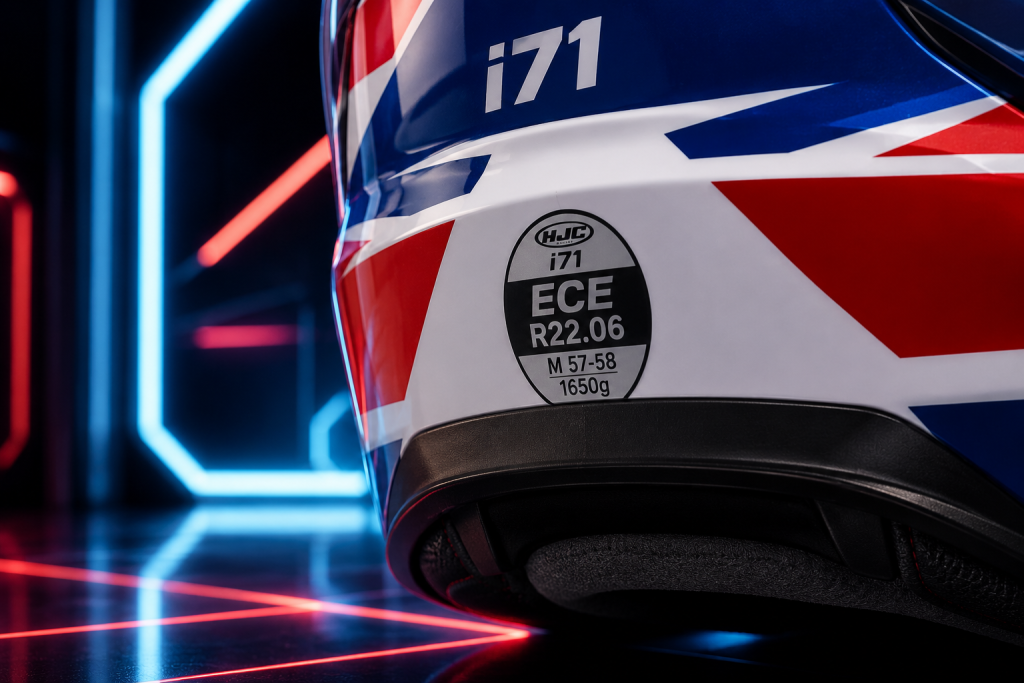
For riders looking at modern mid-range HJC helmets like the HJC i71 or the HJC C10, the ECE R22.06 sticker on the rear gales is far more than a basic regulatory label. It represents a quantum leap in impact physics and shell resilience. To help you understand the immense defensive value built into your gear, this technical guide will demystify the rigorous science behind the ECE R22.06 standard, analyze the brutal testing matrix it enforces, and explain how HJC engineers its advanced shells to conquer these strict new thresholds without compromising affordability or daily convenience.
1. The Core Evolution: Why the Old ECE 22.05 Standard Had to Change
To understand the protective superiority of the new ECE R22.06 mandate, we must first look at the structural shortcomings of its predecessor, ECE 22.05, which was established way back in 2002. While 22.05 saved countless lives, its testing methodology was developed based on decades-old accident data.
Under the old 22.05 regime, helmets were evaluated by dropping them in a clean, perfectly vertical line onto a flat steel anvil. Furthermore, laboratory technicians were required to strike the helmet shell on exactly five pre-determined, highly predictable impact points.
Over time, this created an engineering loophole across the global helmet manufacturing industry. Because the impact zones were completely predictable, a manufacturer could structurally reinforce only those specific five points with extra padding or denser EPS foam while leaving the rest of the shell thinner to save weight and production costs.
Additionally, the old drop tests only measured linear acceleration—the straight, front-to-back force that causes skull fractures. It completely ignored rotational acceleration, which medical science now recognizes as the primary cause of severe, long-term traumatic brain damage. The ECE R22.06 standard was created specifically to close these testing loopholes and force manufacturers to deliver uniform, comprehensive head protection across every square inch of the shell.
2. Rotational Acceleration: The Fight Against Brain Shear Injury
The most revolutionary upgrade introduced by the ECE R22.06 framework is the mandatory inclusion of oblique (angled) impact testing to measure rotational acceleration. When a rider crashes on a public street or highway, they do not simply drop vertically like a stone; they hit the pavement at a diagonal angle while moving forward at high speed.
As the outer shell grips the rough asphalt, the helmet experiences sudden friction, forcing it to spin violently. This sudden twisting motion translates directly to the rider’s skull, causing the brain to twist inside the cerebrospinal fluid—a phenomenon known as brain shear. This twisting tears microscopic blood vessels and neural networks, resulting in life-altering internal injuries even if the external skull remains completely unbroken.
+-----------------------------------------------------------------------+
| ECE R22.06 OBLIQUE IMPACT PROTOCOL                                    |
+-----------------------------------------------------------------------+
| Impact Angle: 45 degrees against a highly solid steel anvil           |
| Anvil Surface: Features raised metallic bars to maximize grip/friction|
| Sensor Array: 9 specialized accelerometers inside a biofidelic headform|
| Primary Metric: Brain Injury Criterion (BrIC) rotational thresholds  |
+-----------------------------------------------------------------------+
To pass this strict evaluation, modern HJC helmets are mounted onto advanced, sensor-packed headforms and dropped at an angle onto a 45-degree anvil fitted with raised metallic bars. This rough surface catches the shell, forcing a severe rotational twist.
The internal sensors calculate the exact twisting forces transferred into the helmet. By forcing the shell and the internal multi-density EPS liner to actively absorb and deflect these shearing forces, ECE R22.06 ensures that helmets provide real-world defense against complex, multi-axis road accidents.
3. The Expanded Testing Matrix: Variable Speeds and Expanded Impact Points
Beyond addressing rotational forces, the ECE R22.06 standard significantly expands the traditional linear impact testing matrix, making it mathematically impossible for manufacturers to utilize localized structural shortcuts.
18 Random Impact Points
Instead of hitting the exact same five predictable spots, ECE R22.06 test technicians are empowered to strike the helmet across 18 distinct, randomly selected impact vectors. This includes crucial areas like the lower chin bar rim, the upper brow line, and asymmetric lateral points. The helmet must exhibit uniform energy dissipation across all zones, ensuring a complete, continuous shield of protection around the entire skull.
High and Low-Velocity Testing
The old standard evaluated impacts at a single, fixed velocity of 7.5 meters per second. The ECE R22.06 framework introduces a multi-tiered velocity battery, dropping helmets at both lower and significantly higher speeds:
The High-Velocity Test (8.2 m/s): Simulates severe, high-energy highway impacts, testing the maximum structural limits of the outer shell matrix to prevent catastrophic cracking.
The Low-Velocity Test (6.0 m/s): Simulates low-speed urban falls. This test is critical because if a helmet’s EPS foam liner is engineered too stiffly to pass high-speed tests, it will fail to compress during a minor fall, transferring a harsh, concussive wave directly into the rider’s skull.
Satisfying both extreme velocity thresholds forces manufacturers to develop advanced, multi-layered, and multi-density EPS foam liners capable of managing varied levels of kinetic energy.
4. Visor Ballistics and Accessory Homologation Upgrades
A motorcycle helmet’s protective duties extend far beyond the shell; the optical visor must shield the rider’s face from high-velocity flying debris like loose gravel or road stone. ECE R22.06 introduces a brutal visor ballistic impact test.
The clear face shield is subjected to a strike from a 6mm steel ball bearing fired at a terminal velocity of 60 meters per second (approximately 134 mph). To clear this hurdle, the visor must not shatter, crack open, or detach from its pivot mechanisms, and the locking latch must stay firmly closed, preventing high-speed road debris from making contact with the rider’s eyes.
Accessory Integration Safety
Furthermore, the R22.06 mandate completely changes how official accessories are governed. Under the old rules, adding an aftermarket Bluetooth communicator or an internal sun visor to a helmet was never officially safety-evaluated.
The ECE R22.06 protocol dictates that any official accessory—such as the integrated Smart HJC 21B and 50B Bluetooth systems or internal drop-down sun shields—must be physically installed inside the helmet during the official crash testing process.
This protocol ensures that adding communication modules or carving out a storage cavity for an internal sun shield does not compromise the structural integrity of the surrounding EPS foam matrix or create dangerous external catch points.
5. How HJC Masters ECE R22.06 Without Adding Excessive Weight
The immense structural demands of satisfying the ECE R22.06 standard inherently require thicker shells and denser internal padding. For many manufacturers, this resulted in a wave of heavy, bulky, and bloated helmets that caused severe rider neck fatigue. HJC, however, successfully avoided this issue across its new lines by leveraging advanced Computer-Aided Design (CAD) technology and refined material science.
Take the HJC i71 and HJC C10 as premier examples. HJC utilizes an Advanced Polycarbonate Composite Shell that is mathematically sculpted to optimize organic aerodynamic pathways while varying shell thickness where it is needed most.
By strategically thickening high-risk impact zones while keeping non-impact areas thin and flexible, HJC balances structural rigidity with a lightweight profile. Internally, HJC layers multi-density, segmented EPS liners that slide slightly against one another, effectively neutralizing rotational friction during oblique impacts.
By applying these advanced engineering techniques, HJC delivers world-class ECE R22.06 certified protection across its mid-range catalog, ensuring everyday riders receive premium protection at an accessible price point.
ECE R22.06 Summary: Pros and Cons for Value Seekers
Pros
Unparalleled Protection: Drastically superior defense against rotational brain injuries and oblique impacts compared to legacy standards.
Rigorous Uniform Testing: Evaluated across 18 random points, eliminating localized structural shortcuts or manufacturing blind spots.
Ballistic Defenses: visors are scientifically certified to withstand 134 mph high-speed stone and debris impacts.
Safe Connectivity: Integrated accessories like Smart HJC Bluetooth systems are fully crash-tested and certified to maintain shell safety.
Cons
Firm Initial Ergonomics: Meeting 22.06 regulations requires dense, highly supportive 3D padding, which can feel quite tight across the jawline during the initial break-in hours.
Final Verdict
The ECE R22.06 safety standard represents a vital milestone in the evolution of motorcycle head protection. By abandoning outdated testing protocols and forcing helmets to conquer complex rotational forces, variable impact velocities, and ballistic visor strikes, this standard ensures that any helmet carrying its badge offers a genuine shield of defensive armor. HJC’s ability to seamlessly integrate this elite level of certification into its mid-range sport-touring and street lines without inflating costs or adding cumbersome weight is an authentic triumph of modern engineering. When you buy an ECE R22.06 certified HJC helmet, you are investing in a world-class asset that keeps your brain safe across every single mile of your journey.
