
Technology & Safety Standards Breakdown, Post
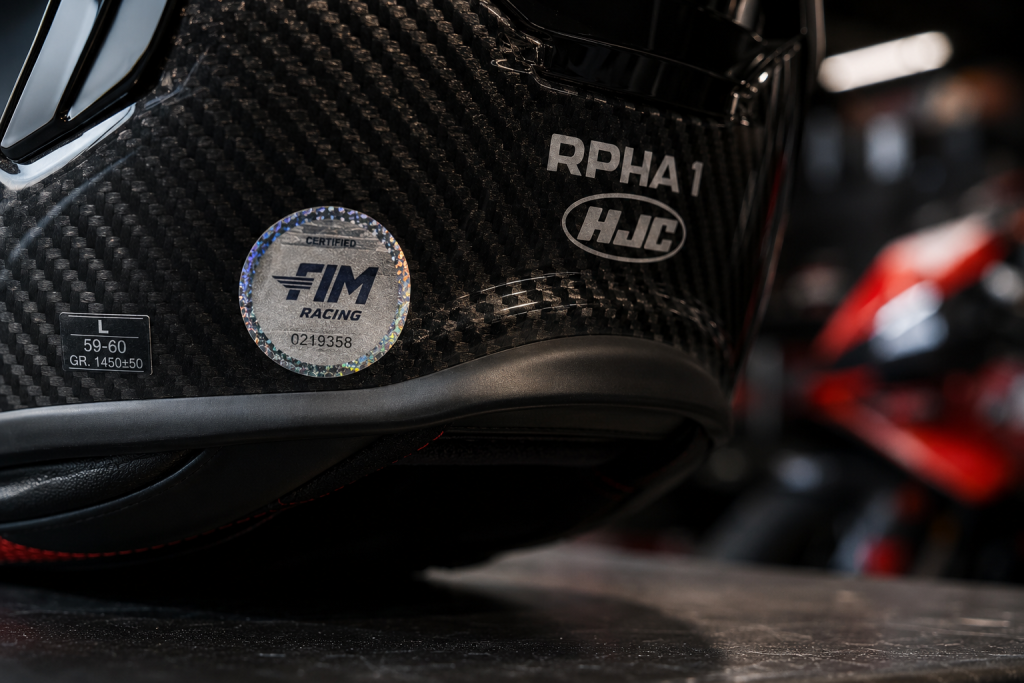
What Is the Prestigious FIM Safety Certification (FRHPhe-01) on the HJC RPHA 1?
May
HJC To anyone outside the high-velocity world of motorcycle racing, a helmet might look like a relatively simple piece of protective equipment—a hard outer plastic shell lined with a layer of foam and fabric. However, within elite racing paddocks such as MotoGP and the World Superbike Championship (WorldSBK), a helmet is viewed as a highly complex, meticulously engineered survival capsule. On any given race weekend, professional factory riders routinely travel at speeds exceeding 220 mph and lean their machines into corners just inches off the asphalt. In this extreme environment, traditional safety standards are no longer sufficient.
Historically, street riders looked at regional safety badges like DOT in North America or ECE in Europe as the gold standards of head defense. But as motorcycle engine performance skyrocketed over the past two decades, the international racing community realized that commercial safety certifications were failing to simulate real-world racetrack crashes.
To bridge this critical safety gap, the Federation Internationale de Motocyclisme (FIM)—the global governing body for motorcycle racing—established the FIM Racing Homologation Programme for Helmets (FRHPhe-01).
When HJC launched its flagship racing weapon, the HJC RPHA 1, its crowning achievement was securing this prestigious FIM safety badge across every single available shell size. In this comprehensive technical breakdown, we will demystify the rigorous engineering science behind the FIM FRHPhe-01 certification, examine the brutal laboratory testing protocols it demands, and analyze why having this badge on the HJC RPHA 1 makes it an invaluable asset for track racers and safety-conscious street riders alike.
1. The Regulatory Evolution: Why Standard Certifications Aren’t Enough
To truly appreciate the prestige of the FIM certification, it is essential to contrast it against the baseline commercial standards that govern the global helmet market. For decades, standard helmet manufacturing focused almost exclusively on managing linear impacts.
The DOT Standard (North America): This is a basic, legally mandated standard that relies heavily on a manufacturer self-testing protocol. The tests are rudimentary, and the standard does not account for modern rotational injury dynamics.
The ECE R22.06 Standard (Europe): A modern and highly rigorous commercial standard that evaluates helmets across a variety of impact speeds and introduces a basic rotational framework. It is an exceptional baseline for street riding, but its thresholds are optimized for public road speeds, not closed-circuit racing velocities.
Commercial testing methodologies typically evaluate a helmet by dropping it in a perfectly straight, vertical line onto a smooth, flat steel anvil. While this successfully measures a helmet’s ability to prevent skull fractures from a direct drop, it ignores a fundamental reality of motorcycle crashes: riders rarely fall in a perfect vertical line. When a rider crashes at high speed, they strike the ground at an oblique angle while maintaining massive forward kinetic momentum. As the helmet grips the rough asphalt, it spins violently. This sudden rotational twisting force is transferred directly to the rider’s skull, causing the brain to twist violently inside the cerebrospinal fluid—a phenomenon known as rotational acceleration. This twisting creates immense internal stress, tearing delicate blood vessels and nerve fibers, leading to severe traumatic brain injuries such as diffuse axonal injury (DAI), even if the external skull remains completely unbroken. The FIM certification was created explicitly to conquer this hidden danger.
2. Inside the FIM Laboratory: The Brutal Oblique Impact Protocol
The absolute core of the FIM FRHPhe-01 standard is its revolutionary oblique impact testing battery. FIM engineers completely abandoned the traditional flat-drop methodology, replacing it with a test configuration engineered to measure rotational friction and brain shear forces with microscopic accuracy.
+-----------------------------------------------------------------------+
| FIM FRHPhe-01 OBLIQUE IMPACT TESTING MATRIX                          |
+-----------------------------------------------------------------------+
| Drop Velocity: 8.0 meters per second (approx. 18 mph pure downward)  |
| Impact Surface: 45-degree angled anvil wrapped in 80-grit abrasive   |
| Impact Locations: 15 distinct, randomly pre-calculated entry vectors   |
| Evaluation Metric: Brain Injury Criterion (BrIC) & Rotational G-force|
+-----------------------------------------------------------------------+
During this test, the HJC RPHA 1 shell is mounted onto a highly advanced, biofidelic headform that perfectly mimics the weight distribution and structural flexibility of a human head and neck. This headform is packed with ultra-precise triaxial accelerometers and angular rate sensors.
The helmet is then dropped at a velocity of 8.0 meters per second onto a 45-degree angled anvil. Crucially, the surface of this angled steel anvil is wrapped in highly abrasive, 80-grit sandpaper. This rough texture creates extreme friction against the helmet shell, forcing it to grab the surface and twist violently upon impact—simulating a racer hitting trackside asphalt or gravel traps at high speed.
To pass, the helmet must keep the Brain Injury Criterion (BrIC) and peak angular acceleration well below strict safety thresholds. The helmet must demonstrate that its outer shell and internal multi-density EPS liner work together to dissipate the twisting energy before it reaches the brain fibers. FIM executes this test across 15 distinct impact locations on the shell, ensuring that there are zero weak points or localized structural vulnerabilities anywhere on the helmet.
3. High-Velocity Penetration and High-G Linear Crash Evaluation
While conquering rotational forces is the primary objective of the FIM standard, the certification also demands extreme performance across traditional linear defense metrics. The FRHPhe-01 battery Subjects the helmet to high-velocity linear drops against both flat and hemispherical anvils at impact speeds significantly higher than standard commercial protocols.
Furthermore, the FIM standard includes a brutal penetration resistance test. A heavy, highly sharpened steel punch is dropped from a significant height directly onto the helmet shell. This test simulates worst-case track scenarios, such as a sharp motorcycle footpeg, a broken handlebar clip-on, or loose track debris flying backward from a leading bike and striking a trailing rider’s head at terminal velocity.
To clear this hurdle, the helmet’s outer composite shell must exhibit immense localized puncture resistance, completely preventing the sharp metal object from piercing through the structure and contacting the internal EPS foam core.
4. How the HJC RPHA 1 Engineered Mastery Over the FIM Standards
Passing the FIM FRHPhe-01 protocol is so structurally demanding that it frequently forces helmet manufacturers to add massive amounts of extra material, resulting in bulky, excessively heavy helmet shells that cause severe neck fatigue over a long race distance. HJC, however, bypassed this engineering compromise by utilizing advanced material science and aerospace-grade chemistry to design their proprietary P.I.M. Plus (Premium Integrated Matrix Plus) shell architecture.
The RPHA 1’s P.I.M. Plus shell utilizes an intricate, multi-layered weave of highly specialized technical fibers:
High-Modulus Carbon Fiber: Forms the rigid baseline grid, providing immense structural tensile strength while keeping structural weight incredibly low.
Carbon-Glass Hybrid Fiber: Woven directly into the matrix to optimize energy absorption pathways and provide superior resistance against sharp punctures.
Aramid (Kevlar) & Structural Fiberglass: Introduces a calculated level of micro-elasticity to the outer shell.
This specific material flexibility is HJC’s secret weapon for defeating the FIM oblique test. When the RPHA 1 strikes the 45-degree abrasive anvil, the P.I.M. Plus shell undergoes controlled, localized deformation.
By flexing slightly upon initial contact, the shell acts like a crumple zone, absorbing and scattering the shearing friction across the wider surface of the ma trận matrix before that energy can translate into internal rotational movement. Supported internally by a segmented, multi-density EPS liner that absorbs varied levels of G-force, the RPHA 1 achieved full FIM homologation across all consumer sizes without becoming heavy or bloated.
5. Beyond the Track: Why Everyday Street Riders Need FIM Protection
A common misconception among casual motorcyclists is that an FIM-certified helmet like the HJC RPHA 1 is “overkill” for public roads, arguing that racing gear belongs strictly on the track. This logic completely misunderstands the unpredictable nature of street accidents.
In reality, a public street is an incredibly hostile environment compared to a closed racing circuit. Racetracks feature smooth asphalt, uniform gravel traps, and massive energy-absorbing air barriers designed to slide a fallen rider to a safe stop. Public roads, conversely, are littered with unpredictable hazards, including concrete curbs, steel guardrails, utility poles, and oncoming passenger vehicles.
A rider falling off their motorcycle at 45 mph on a public street will encounter the exact same asphalt friction and dangerous rotational forces as a professional racer crashing on a circuit. In fact, catching a helmet on a raised concrete curb or a roadside pothole can create rotational twisting forces far more violent than a typical low-side track slide.
By investing in an FIM-homologated helmet like the HJC RPHA 1, a street rider is not paying for marketing vanity or a racing aesthetic; they are purchasing the absolute highest level of brain and skull protection science can currently produce.
Final Review Summary: Pros and Cons
Pros
Ultimate Safety Badge: Official FIM certification provides unparalleled, scientifically proven defense against dangerous rotational brain injuries.
Premium Composite Shell: P.I.M. Plus material matrix maximizes impact absorption and puncture defense without adding excessive neck weight.
Zero Structural Blind Spots: Extensively tested across 15 distinct impact vectors for complete, uniform protection.
MotoGP Heritage: Built to the exact structural safety specifications trusted by the world’s fastest factory racers.
Cons
Prohibitive Financial Investment: Elite safety homologation and premium composite materials position the helmet at a premier price point.
Strict Track Priorities: Omits common casual street luxuries—such as an internal drop-down sun visor—to preserve maximum structural integrity for the EPS core.
Final Verdict
The FIM safety certification (FRHPhe-01) emblazoned on the rear gales of the HJC RPHA 1 is far more than a basic graphic badge—it is an authentic certificate of elite structural defense. By conquering the complex physics of rotational acceleration and brain shear forces through advanced P.I.M. Plus composite engineering, HJC has delivered a true masterclass in head protection. It completely eliminates the guesswork associated with purchasing safety gear, providing riders with an absolute ceiling of impact defense. Whether you are a dedicated track racer looking to slice seconds off your lap times or a street enthusiast who refuses to compromise on the safety of your brain, the FIM-approved HJC RPHA 1 is an exceptional, life-saving asset that is absolutely worth every single penny.
