Brand Heritage & Racing Legacy, Post
The History of HJC Helmets: From Small Workshop to Global Market Leader
May
In the fiercely competitive landscape of motorcycle safety gear, brand longevity is rarely a matter of luck. The industry is crowded with legacy European manufacturers boasting century-old histories and boutique Japanese brands defined by artisanal precision. Yet, standing at the absolute summit of the global market—holding the title of the #1 helmet manufacturer in North America since 1992—is a South Korean powerhouse that began with a far more modest vision.
The story of HJC Helmets is not just a corporate timeline; it is a masterclass in specialized manufacturing, disciplined engineering, and an unwavering commitment to a singular goal: providing high-quality head protection that is accessible to every rider on Earth. From its inception as a small, local workshop in 1971 to its current status as a MotoGP-dominating titan, HJC has redefined what it means to be a “value-driven” brand.
In this first installment of Group 4, we will journey through the history of HJC, analyzing the strategic pivots that allowed a small Korean firm to outmaneuver global giants, the technical innovations that birthed the RPHA series, and the philosophy that continues to drive the brand in 2026.
1. 1971: The Genesis of the “Hong Jin” Vision
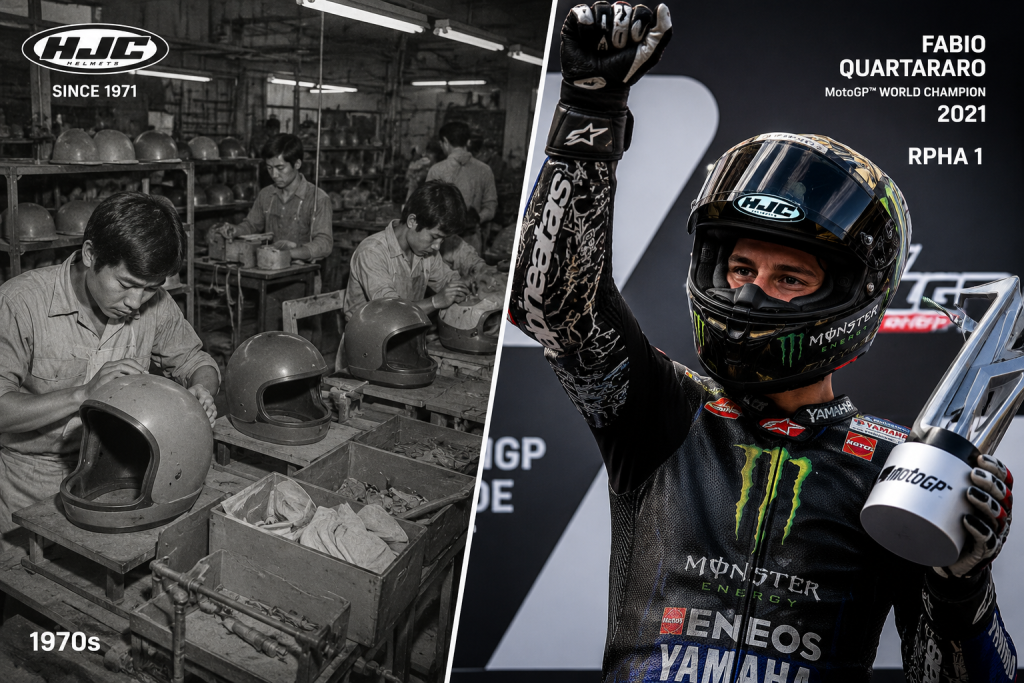
The HJC story began in the early 1970s, a period when the South Korean economy was rapidly industrializing. In 1971, Wan Kee Hong founded a small company under the name Hong Jin Crown (HJC). At the time, the motorcycle industry was exploding, but high-quality protective gear was often prohibitively expensive, reserved primarily for professional racers or the wealthy elite in Western markets.
Wan Kee Hong recognized a critical gap in the market. He didn’t want to build just another luxury item; he wanted to democratize safety. The early HJC workshops were defined by a “Quality First” mantra. Unlike other manufacturers that diversified into various types of sporting equipment, Hong Jin made the strategic decision to focus exclusively on motorcycle helmets. This hyper-specialization allowed the small team to master the complex chemistry of polycarbonate resins and the structural physics of impact-absorbing liners far more deeply than their multi-industry competitors.
The Foundation of Specialized Manufacturing
By focusing on a single product, HJC was able to refine its manufacturing pipelines. They were early adopters of integrated production, where the shell molding, EPS lining, and final assembly were all handled under one roof. This vertical integration was the secret weapon that allowed them to maintain rigorous quality control while keeping retail prices significantly lower than the imported European alternatives.
2. The 1980s: The North American Pivot and the Quality Revolution
While HJC dominated the domestic Korean market, the 1980s marked the brand’s most ambitious move: entering the United States. To succeed in America, HJC knew they couldn’t just compete on price—they had to conquer the most rigorous safety standards in the world, specifically the DOT and SNELL certifications.
During this decade, HJC invested heavily in automated manufacturing and research. They began utilizing early CAD (Computer-Aided Design) technologies to sculpt helmet shells that were more aerodynamic than the “bubble” shapes common at the time. This era saw the introduction of the first HJC helmets that didn’t just look “good for the price,” but offered features—like removable liners and advanced ventilation—that rivaled premium brands.
1992: Reaching the Summit
The strategy paid off with historic results. By 1992, less than two decades after entering the international market, HJC officially became the #1 helmet brand in North America in terms of market share. They had successfully convinced the American riding public that a “mid-range” price point didn’t have to mean “mid-range” safety. For the next 30+ years, they have maintained this dominant position, a feat of market consistency that is virtually unheard of in the gear industry.
3. Engineering Mastery: The In-House Wind Tunnel and P.I.M. Plus
As HJC moved into the 2000s, they faced a new challenge. They were the masters of the mid-range, but they wanted to prove they could compete at the absolute pinnacle of racing performance. To do this, they realized they could no longer rely on external laboratories.
In 2007, HJC made a massive capital investment by building their own state-of-the-art, high-velocity wind tunnel at their global headquarters. This was a turning point in the brand’s history. By being one of the few helmet manufacturers in the world with a dedicated in-house wind tunnel, HJC’s engineers could run thousands of simulations on shell vibration, wind noise, and high-speed lift.
+-----------------------------------------------------------------------+
| MILESTONES OF HJC INNOVATION                                          |
+-----------------------------------------------------------------------+
| 1971: Hong Jin Crown founded in South Korea.                          |
| 1986: Entry into the US market with DOT/SNELL approval.               |
| 1992: Achieves #1 market share status in North America.               |
| 2007: Construction of the in-house high-speed wind tunnel.            |
| 2012: Launch of the RPHA series (Revolutionary Performance).          |
| 2021: Celebrating 50 years of specialized head protection.            |
+-----------------------------------------------------------------------+
The Birth of the RPHA Series
This technological independence led to the development of the P.I.M. (Premium Integrated Matrix) technology—a complex weave of carbon fiber, aramid, and fiberglass. In 2012, HJC launched the RPHA 10, the first in a line of “Revolutionary Performance” helmets. The RPHA series effectively signaled to the world that HJC was no longer just the king of the “value” segment; they were now a legitimate threat to the high-end racing market, delivering flagship performance at a price that still undercut the competition.
4. The Racing Pedigree: From the Street to the MotoGP Podium
A brand’s history is written on the track as much as it is in the factory. To validate their engineering, HJC entered the most brutal testing ground on Earth: Grand Prix motorcycle racing.
Over the last decade, HJC has partnered with some of the most iconic names in the sport. The brand famously supported Ben Spies (the “Texas Terror”) during his dominant World Superbike and MotoGP years. More recently, the HJC logo has been seen at the front of the MotoGP grid on the heads of Fabio Quartararo (the 2021 World Champion), Brad Binder, and Cal Crutchlow.
The RPHA 1: The Ultimate Validation
The culmination of this racing history is the HJC RPHA 1. It was the first HJC helmet to receive the official FIM Homologation, the strictest safety standard in existence. By developing the RPHA 1, HJC proved they could build a helmet capable of protecting a rider during a 360 km/h crash, essentially completing their journey from a small workshop making local commuter gear to a global leader providing “flight gear” for the fastest humans on the planet.
5. HJC Today: Global Presence and Future Vision
As we stand in 2026, HJC operates four massive manufacturing plants across South Korea and Vietnam, producing millions of helmets annually. They have expanded into specialized segments, including motocross, snowmobiling, and high-end cycling helmets, all while maintaining their core focus on head protection.
A Legacy of Choice
Perhaps the most significant part of HJC’s history is their refusal to abandon the budget-conscious rider. Even as they produce $900 FIM racing lids, they continue to innovate on helmets like the C10 and i71, ensuring that the safety technology developed for Fabio Quartararo eventually “trickles down” to the 17-year-old student riding a scooter in Da Nang or the commuter in Los Angeles.
“We are not just selling helmets; we are selling the peace of mind that allows a rider to enjoy the machine.” — A core philosophy reflected throughout HJC’s fifty-year history.
Final Review Summary: The HJC Legacy
| Era | Focus | Result |
| 1970s | Hyper-specialization | Mastered polycarbonate and EPS chemistry. |
| 1980s-90s | International expansion | Became #1 brand in North America. |
| 2000s | R&D Independence | Built in-house wind tunnel; developed P.I.M. |
| 2010s-20s | Elite Racing | FIM Homologation; MotoGP World Championships. |
Final Verdict
The history of HJC is a testament to the power of focus. By refusing to diversify into clothing or motorcycle accessories, and by obsessing over the physics of a single product for over half a century, Hong Jin Crown transformed from a local Korean shop into a global icon of safety. They proved that “affordable” doesn’t have to mean “unsafe,” and that through disciplined engineering and a racing-first mindset, a brand can rise to protect the world’s most elite athletes. When you put on an HJC helmet today, you aren’t just wearing foam and plastic; you are wearing 55 years of specialized evolution.
