
Rider Guides & Expert Maintenance Tips, Post
The Expert’s Guide to Long-Term Helmet Storage: How to Protect Your Investment During the Off-Season
May
Whether you are a student taking a semester break, a software developer entering a high-intensity “sprint” that keeps you off the road, or a rider facing the humid monsoon season of Central Vietnam, there will be times when your HJC helmet needs to go into “hibernation.”
Many riders assume that as long as the helmet isn’t being dropped or crashed, it is perfectly safe sitting in the corner of a garage or on a shelf. This is a costly misconception. Improper long-term storage is an invisible enemy that can prematurely age your helmet, turning a premium RPHA 12 or i71 into a degraded, unhygienic, and structurally compromised liability. From the humidity that encourages mold growth to the chemical vapors in a garage that can melt EPS foam, the environment where your helmet “sleeps” matters just as much as how it performs at 100 km/h.
In this final installment of Group 3, we will explore the professional protocols for long-term helmet storage. We will cover the “Deep Decontamination” phase, the science of humidity control, the structural dangers of hanging by the strap, and the critical “Re-entry Audit” you must perform before your first ride back.
1. Phase 1: The “Clean-Room” Protocol Before Storage
The most common mistake riders make is storing a “lived-in” helmet. If you place your helmet in a bag while it still contains trace amounts of sweat, skin oils, or hair products, you are essentially sealing a biological petri dish. Over three months of non-use, those organic materials will ferment, leading to permanent staining and a foul odor that no amount of spray can fix.
The Interior Sanitization
Before storage, you must perform a deep clean of the liners (see Article #20). Ensure they are 100% bone-dry. Even 5% residual moisture trapped deep in the 3D foam can trigger a colony of black mold in a dark storage bag.
The Exterior Decontamination
Clean the outer shell and the visor meticulously. Remove any dead insects or road grime. Dried insect guts are acidic; if left on the clear coat for months, they can “etch” into the paint, leaving permanent ghost marks that cannot be polished out. Lubricate the rubber gaskets with HJC silicone oil (see Article #21) to prevent the rubber from drying out and cracking while in storage.
2. The Environmental War: Humidity, Chemicals, and UV
Where you choose to “park” your helmet is the difference between preservation and degradation. A motorcycle helmet is a complex chemical matrix, and it is sensitive to its surroundings.
The Humidity Factor
In tropical climates like Da Nang, humidity is the primary threat. High humidity causes “dry rot” in the interior fabrics and weakens the adhesives holding the vents and gaskets.
The Solution: Store the helmet in a climate-controlled room (like a bedroom or office) rather than a damp garage or an outdoor balcony. If you live in an exceptionally humid area, place a silica gel packet or a bamboo charcoal bag inside the chin bar to act as a silent moisture vacuum.
The Chemical Vapor Zone
Never store your helmet in the same area as gasoline cans, paint thinners, or cleaning solvents.
The Science: The vapors from these chemicals (especially petroleum-based ones) can chemically react with the Expanded Polystyrene (EPS) liner. These vapors can literally “melt” the foam beads at a microscopic level, destroying the helmet’s ability to absorb impact energy without you ever seeing a mark on the outside.
The UV Threat
Keep the helmet out of direct sunlight. While HJC uses high-quality UV-resistant clear coats, prolonged “static” exposure to the sun (like on a windowsill) will cause the EPS to heat up and the plasticizers in the shell to slowly migrate, making the helmet brittle over time.
3. The Structural Stance: Position and Weight Distribution
How the helmet physically sits on the shelf dictates the long-term health of its “shocks absorbers” and retention system.
Don’t Hang It by the Strap
Many riders hang their helmets on a coat hook or a wall peg by the chin strap. Stop doing this immediately. 1. It puts a constant, localized “pull” on the rivets that anchor the strap to the shell.
2. Hanging a helmet on a narrow peg puts a concentrated pressure point on the internal EPS liner. Over months, the weight of the helmet will cause the peg to permanently “dent” the EPS, creating a dead spot in the impact protection right at the top of your head.
The “Neutral” Position
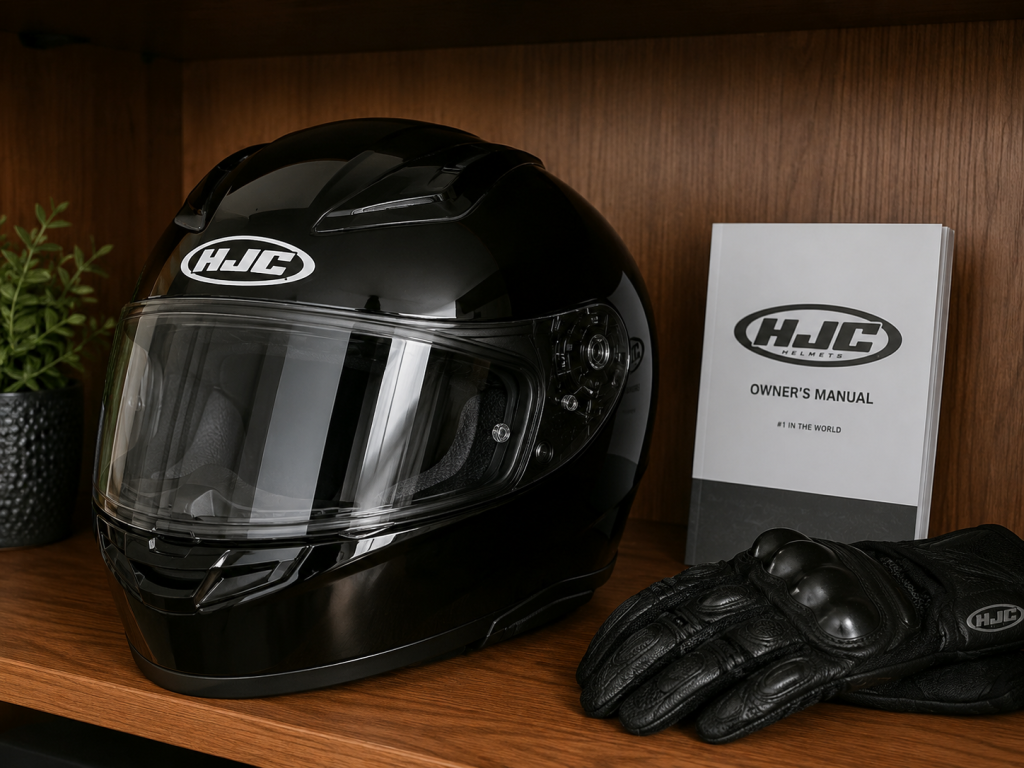
The best way to store an HJC is sitting flat on its base on a level, ventilated shelf. Use the HJC fleece storage bag that came in the box.
Pro Tip: Turn the bag inside out before use to ensure no dust or lint is trapped on the soft interior side. If you have lost your bag, a clean, 100% cotton pillowcase is an excellent substitute—it allows the materials to “breathe” while keeping dust away.
4. The “Spring Awakening” Checklist: Re-entry Inspection
After months of non-use, you cannot simply grab your helmet and hit the road. You must perform a “System Audit” to ensure the gear hasn’t been compromised during its downtime.
The Spider Check: It sounds like a joke, but insects love the dark, warm tunnels of an HJC ventilation system. Use a flashlight to check the brow and crown vents for webs or nests. A spider crawling across your face at 60 km/h is a major distraction that can lead to a crash.
The Visor Operation: Open and close the visor several times. If it feels “crunchy” or stiff, the silicone oil has dried out or collected dust. Clean and re-lubricate the baseplates.
The “Sniff” Test: If there is even a hint of a musty or sour smell, do not ride. It means mold has started to grow. You must perform a full antimicrobial wash before use.
The Strap Tug: Give the chin strap a firm, sharp tug. Ensure the rivets are solid and the webbing hasn’t been chewed by rodents (which is surprisingly common in garage storage).
5. Summary Table: The Long-Term Storage Matrix
| Factor | The “Wrong” Way (Danger) | The “HJC Expert” Way (Safe) |
| Cleaning | Store it “salty” and sweaty. | Deep wash + 100% dry. |
| Location | Garage floor or near gas cans. | Indoor shelf / Climate controlled. |
| Position | Hanging by the strap on a peg. | Sitting flat on the base. |
| Protection | Naked on a shelf. | Inside the HJC fleece bag. |
| Humidity | Trapped in a plastic bin. | Ventilated shelf + Charcoal bag. |
The “Wildcard” Suggestion: Dedicated Gear Storage
If you have multiple helmets or high-end gear (like your ASUS ROG laptop and HJC racing lid), consider investing in a dedicated helmet cabinet or a specialized “Helmet Fan Stand.” These stands feature a built-in, low-RPM fan that gently circulates air through the helmet even while it is sitting on the shelf, ensuring that stagnant humidity never has a chance to settle. It turns your storage into an active maintenance cycle.
Final Verdict
Your HJC helmet is a high-performance asset that deserves respect, even when it isn’t being used. By treating the storage phase as a “Maintenance Sprint,” you protect the chemical integrity of the EPS, the elasticity of the gaskets, and the hygiene of the Silvercool interior. A helmet that is stored correctly is a helmet that is ready to perform its life-saving duty the very second you click the visor shut and kick the kickstand up helmet.
