
Technology & Safety Standards Breakdown, Post
Inside HJC’s Silvercool Interior Liner: The Secret to Keeping Your Helmet Odor-Free
May
HJC For dedicated motorcycle riders, the relationship with a helmet is intensely personal. It is the piece of safety equipment that wraps closely around your face, temples, and jawline across thousands of miles of open road. During the height of the riding season, your helmet shields you from the elements, but it also becomes a localized containment zone for human biology. Whether you are attacking a technical racing circuit on a sportbike or navigating gridlocked urban traffic during a hot summer commute, your body reacts to physical stress by sweating.
Over a multi-month riding season, this repeated thermal cycle creates an unpleasant reality. Standard helmet fabrics easily trap moisture, leading to the accumulation of sweat, facial oils, and hair products within the dark, enclosed environment of the padding. Left unmanaged, this damp ecosystem becomes a breeding ground for bacteria and mold, resulting in a distinct, foul odor that greets you every time you pull the helmet over your head.
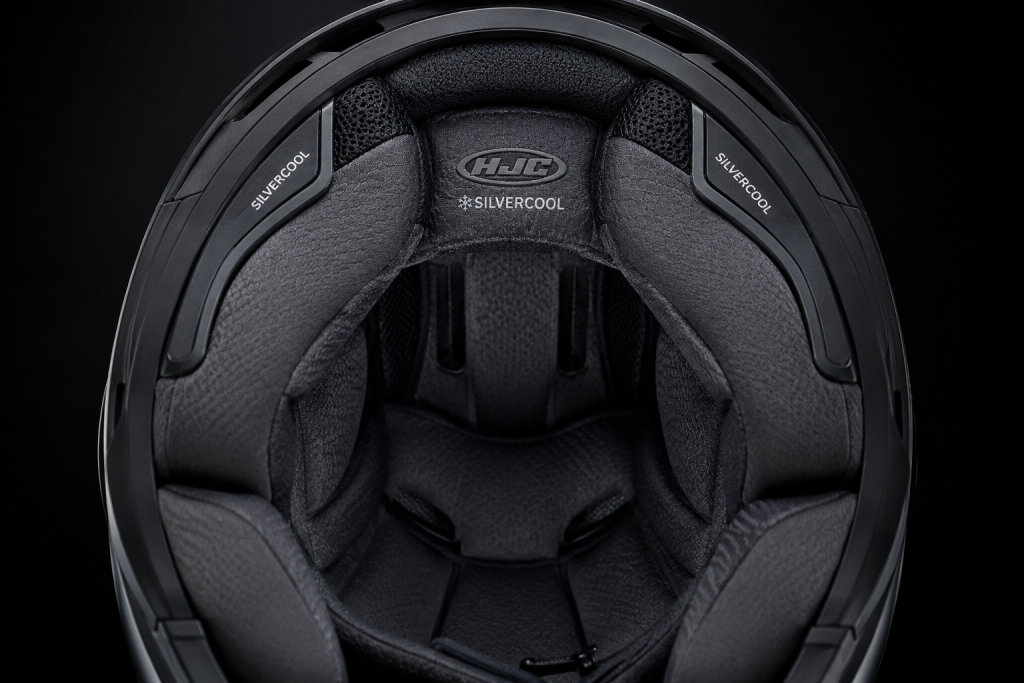
To eliminate this hygienic nightmare without forcing riders to execute daily, tedious cleanings, HJC Helmets engineered an advanced textile defense grid integrated across their premium and mid-range lineups: the Silvercool interior liner. By micro-infusing antimicrobial metallic properties directly into a high-performance fabric weave, HJC systematically prevents the biological reactions that cause helmet odors.
In this comprehensive technical breakdown, we will examine the underlying science of how HJC’s Silvercool technology defeats odor-causing bacteria, analyze its moisture-wicking capillary architecture, and provide an expert maintenance guide to keep your helmet interior fresh and comfortable across every single mile of your journey.
1. The Biological Threat: Why Motorcycle Helmets Develop Foul Odors
To understand why traditional helmet fabrics fail and how Silvercool technology succeeds, it is necessary to examine the underlying micro-biology of human sweat and skin contact. A common misconception among casual riders is that human sweat naturally possesses a bad smell. In reality, fresh sweat excreted by your eccrine glands is composed almost entirely of water, trace salts, and micro-proteins, and is completely odorless when it first contacts the fabric.
The real culprit behind the notorious “old helmet smell” is a family of microscopic bacteria that naturally live on human skin, primarily Staphylococcus aureus and various corynebacterial strains. When you ride, your scalp and face secrete sweat along with sebum (natural skin oils) and dead skin cells. The porous foam and fabric of a standard helmet liner absorb these organic compounds, locking them inside a warm, dark, and highly humid space.
Warm Body Heat + Trapped Moisture (Sweat) + Organic Skin Oils (Sebum)
                          |
                          v
   Explosive Bacterial & Fungal Multiplication Inside Fabric
                          |
                          v
Bacterial Breakdown of Organic Matter --> Production of Thioalcohols & Fatty Acids
                          |
                          v
         Persistent, Stale, and Sour Helmet Odors
For bacteria, this environment is a perfect paradise. They multiply exponentially, consuming the proteins and lipids trapped within the textile fibers. As these microorganisms digest the organic materials, they excrete volatile chemical compounds—such as thioalcohols and isovaleric acid—which carry a highly pungent, sour, and stale odor. Once these compounds bond with standard synthetic fabrics like cheap nylon or basic polyester, the smell becomes deeply embedded, making it incredibly difficult to wash out.
2. The Antimicrobial Science of Silvercool Fabric Technology
HJC’s Silvercool technology directly conquers this bacterial lifecycle by weaponizing a natural element that humans have used to combat disease for thousands of years: pure silver. Within the medical and aerospace fields, silver is globally recognized as one of the most powerful, non-toxic antimicrobial agents in existence.
Rather than simply spraying a temporary chemical coating onto a finished liner—which would easily wash away after a few cleaning cycles—HJC micro-infuses silver ions directly into the polymer matrix of the technical fibers during the spinning process. This means the antimicrobial properties are structurally baked into the very DNA of the thread, providing life-long performance.
How Silver Ions Neutralize Bacteria
When moisture from your sweat contacts the Silvercool liner, it activates the embedded silver ions. These ions execute a three-stage mechanical attack on any microscopic organisms that attempt to settle on the fabric:
Cell Wall Disruption: The silver ions bind aggressively to the cellular membrane of incoming bacteria, compromising its physical integrity and causing the cell wall to rupture instantly.
Respiratory Blockade: Once inside the microorganism, the ions interfere with the bacteria’s internal cellular enzymes, completely cutting off its ability to process oxygen and energy. The bacteria are effectively suffocated at a microscopic level.
DNA Inactivation: The silver ions bind to the bacteria’s internal DNA strands, systematically preventing the cell from executing division and replicating.
Because this multi-point attack is purely mechanical and chemical rather than relying on synthetic antibiotics, the bacteria cannot develop a biological resistance to it. The Silvercool lining acts as a continuous, silent sterilization shield, neutralizing 99.9% of odor-causing bacteria the absolute moment they make contact with the padding, keeping the interior of your HJC shell clinically fresh.
3. High-Velocity Moisture Management: Capillary Action and ACS Synchronization
While eliminating bacteria is vital for long-term odor prevention, maintaining immediate, dry riding comfort requires top-tier moisture management. If a helmet liner remains damp with liquid sweat during a long afternoon journey, it will feel cold, heavy, and uncomfortable against your skin, even if it does not smell bad.
The Silvercool fabric matrix is engineered with an advanced capillary wicking layout. Traditional round fabric threads trap water drops in the spaces between the weaves, causing the fabric to act like a heavy sponge. Silvercool fibers, conversely, are engineered with unique, non-circular cross-sections featuring micro-grooves running along the length of each thread.
[Rider Skin Surface] --> Sweats Liquid Moisture
  --> Advanced Capillary Fibers Pull Sweat Away Instantly
    --> Moisture Is Spread Out Evenly Across a Wide Textile Surface Area
      --> Continuous ACS Internal Wind Stream Evaporates Sweat Instantly
        --> Scalp Remains Uniformly Cool, Dry, and Comfortable
Through the natural physics of capillary action, these microscopic grooves act as hydraulic pumps, instantly drawing liquid sweat away from your skin surface and pulling it toward the outer layers of the textile.
Once pulled into the outer weave, the moisture is spread out evenly across a massive surface area. This widespread distribution allows the incoming air currents generated by HJC’s ACS (Advanced Channeling Ventilation System) to evaporate the dampness instantly. By working in flawless synchronization with the helmet’s internal EPS air channels, the Silvercool liner ensures your scalp remains completely dry, eliminating the clammy, humid climate that encourages bacterial growth.
4. Ergonomic 3D Contour Architecture and Structural Resilience
Beyond its chemical and biological advantages, HJC’s Silvercool lining is a masterpiece of physical comfort and ergonomic engineering. The interior infrastructure of modern HJC helmets is divided into a segmented crown pad and highly contoured 3D cheek pads.
HJC utilizes multi-density polyurethane foam blocks sculpted via computer modeling to match actual human facial contours. The cheek pads exert a firm, uniform clamp across your jawline, ensuring that the helmet remains perfectly stable and optically aligned at high speeds without creating painful pressure hotspots over hours of riding.
Crucially, the technical foam cores are wrapped securely in the Silvercool textile. This specific fabric selection features a highly durable, low-friction surface finish. When you are pulling the helmet over your head or sliding it off, the fabric glides smoothly against your ears and cheeks, completely eliminating the painful skin abrasion and friction rash common with lower-quality budget headgear.
Furthermore, the Silvercool weave exhibits exceptional structural memory, allowing the padding to maintain its dense, supportive thickness and defensive properties over years of hard street use.
5. Maintenance Protocol: How to Clean and Preserve Your Silvercool Liner
To ensure that the multi-layered defenses of your Silvercool interior remain completely intact throughout the lifespan of your helmet, you must follow a disciplined, gentle maintenance routine. While the silver ions are structurally permanent, allowing dirt, road salt, and dead skin cells to heavily cake the surface of the lining will physically block the silver matrix from interacting with fresh moisture.
Step-by-Step Washing Guide:
Gentle Extraction: Carefully un-snap the cheek pads and the main crown liner from their internal anchoring points inside the EPS shell. Always pull close to the plastic snaps to prevent tearing the fabric.
Lukewarm Hand Wash: Fill a clean basin with lukewarm water (never exceeding 30°C/86°F) and add a small amount of neutral, mild baby shampoo or a dedicated, delicate gear wash. Avoid harsh dish soaps or chemical detergents.
Gentle Agitation: Submerge the liners and massage them gently with your hands, allowing the soapy water to dissolve trapped skin oils. Never scrub the fabric aggressively with stiff brushes.
Thorough Rinse: Rinse the components repeatedly under clean, cool running water until every trace of soap residue is completely purged.
Air Dry in the Shade: Gently press the foam between dry towels to remove excess water drops—never wring or twist the pads. Place the liners on a flat surface in a well-ventilated, indoor space to air dry completely. Never expose them to direct harsh sunlight, and never place them inside a mechanical clothes dryer, as extreme heat will melt the plastic anchoring plates and destroy the fabric fibers.
Final Review Summary: Pros and Cons of HJC Silvercool Technology
Pros
Elite Odor Control: Micro-infused silver ion technology kills 99.9% of odor-causing bacteria mechanically.
Rapid Moisture Wicking: Advanced capillary channels pull sweat away from skin instantly for quick evaporation.
Premium Skin Ergonomics: Low-friction textile finish prevents skin irritation during helmet removal.
Fully Washable Components: Easily removable liners ensure long-term cockpit hygiene.
Cons
Initial Density Break-In: To satisfy strict modern safety certifications, the dense 3D foam beneath the Silvercool fabric requires a brief 5 to 10-hour break-in period before conforming perfectly to your face.
Final Verdict
HJC’s Silvercool interior liner is a quiet, yet profoundly significant triumph of everyday motorcycle engineering. It successfully proves that a full-face protective helmet does not have to transform into a sour, unhygienic environment after a season of hot weather riding. By combining pure silver-ion biochemistry with high-performance moisture-wicking capillary channels and plush 3D ergonomics, HJC has delivered a clean and comfortable internal environment. It allows you to focus entirely on the open road ahead, confident that your gear remains fresh, dry, and hygienic across every single mile of your journey.
