
Technology & Safety Standards Breakdown, Post
Micro Buckle vs. Double D-Ring on HJC Helmets: Which Fastening System Is Best for You?
May
HJC When choosing a high-quality motorcycle helmet, it is remarkably easy to get caught up evaluating the outer composite matrix shell, checking the high-flow ventilation intake statistics, or marveling at the panoramic field of vision provided by the face shield. While these features are undeniably vital for your riding experience, there is one humble, often-overlooked component that plays an absolute make-or-break role in your safety: the chin strap fastening system.
Consider this critical medical fact: you could be wearing the most expensive, FIM-certified carbon fiber helmet on Earth, but if the chin strap is not secured correctly—or if the fastening system fails during an accident—the helmet can easily fly completely off your head during an initial tumble. This leaves your skull entirely defenseless against secondary impacts with concrete curbs, guardrails, or oncoming vehicles.
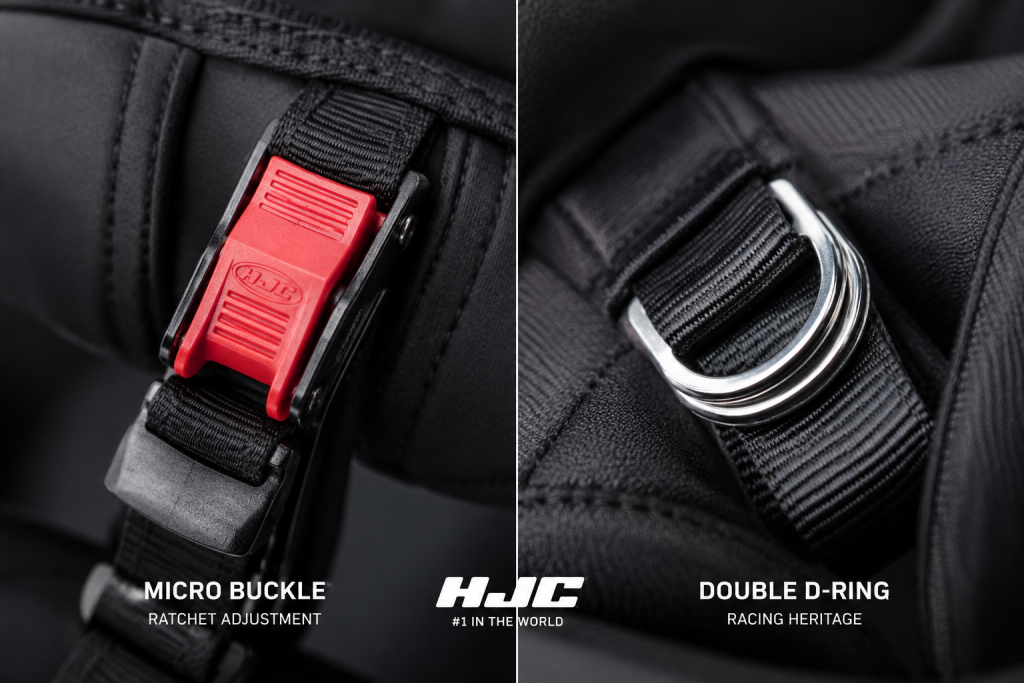
To satisfy the diverse needs of different motorcycle demographics, HJC Helmets utilizes two primary retention mechanisms across their modern lineup: the Micrometric Micro Buckle ratchet system and the classic Double D-Ring loop system. Both retention designs satisfy modern international safety regulations, yet they operate on completely different mechanical, ergonomic, and practical philosophies.
In this comprehensive technical comparison, we will dissect the mechanical kinetics of both the Micro Buckle and the Double D-Ring, analyze their respective structural advantages and drawbacks, and explain how to choose the perfect fastening configuration to match your daily riding lifestyle.
1. The Micrometric Micro Buckle: The Master of Street Convenience
The Micrometric Micro Buckle retention system (often referred to simply as the ratchet strap) is highly favored across the modern sport-touring, commuter, and modular helmet segments. It is engineered specifically for riders who prioritize rapid operational speed and everyday utility in stop-and-go environments.
+-----------------------------------------------------------------------+
| MICRO BUCKLE RETENTION MECHANICS                                      |
+-----------------------------------------------------------------------+
| Strap Material: Reinforced heavy-duty nylon or woven webbing          |
| Male Component: Toothed plastic or steel rachet tongue                |
| Female Component: High-tension metal spring latch casing             |
| Actuation: Click-to-lock incremental steps; pull-tab quick release    |
+-----------------------------------------------------------------------+
Mechanical Execution and Daily Utility
The Micro Buckle functions exactly like a high-end, miniature zip-tie or a ski boot binding. One side of the chin strap features a rigid, toothed plastic or metal ratchet tongue, while the other side houses a spring-loaded mechanical metal latch casing.
To secure the helmet, you simply slide the toothed tongue into the latch casing. As it passes through, you will hear a series of reassuring mechanical “clicks,” with each click tightening the chin strap incrementally closer against your jawline.
The primary asset of the Micro Buckle is its unrivaled operational convenience. It is designed to be operated fluidly using a single gloved hand. When pulling up to a gas station, a border checkpoint, or navigating frequent urban commuting stops, you can release the entire strap instantly by simply pulling downward on a small, high-visibility red ribbon tab attached to the spring latch.
Furthermore, HJC models like the HJC i71 and HJC C70 feature heavily padded fabric undersleeves beneath the ratchet mechanism, ensuring that the hard metal casing never pinches the sensitive skin of your neck or throat, delivering plush, all-day commuting comfort.
2. The Double D-Ring: The Track-Mandated Pinnacle of Absolute Security
Sitting on the completely opposite end of the engineering spectrum is the classic Double D-Ring fastening layout. This system represents the oldest, simplest, and most structurally unyielding retention technology in the motorcycling world. It is the absolute, non-negotiable standard for professional track racing leagues globally, including MotoGP, WorldSBK, and Formula 1.
Mechanical Execution and Absolute Reliability
The mechanical layout of the Double D-Ring completely bypasses complex moving springs, buttons, or interlocking teeth. One side of the chin strap is a clean nylon webbing belt, while the other side anchors two heavy-duty, corrosion-resistant steel or titanium rings shaped like the letter “D.”
To secure the system, you thread the bare nylon strap through both rings simultaneously, loop it back over the first ring, and tuck it through the center of the second ring, pulling it tight to create a self-locking friction knot.
The defining asset of the Double D-Ring is its absolute mechanical simplicity and failure-proof reliability. Because it contains zero moving parts, springs, or latch pins, there is physically nothing that can jam, crack open, or fail over time due to caking dirt, fine sand, or extreme crash forces.
More importantly, the Double D-Ring forces the rider to manually adjust the tension of the chin strap every single time they put the helmet on. This self-correcting mechanical reality completely eliminates the dangerous risk of riding with a loose or stretched-out chin strap, ensuring a flawless, high-tension security lock around your jawline. HJC utilizes this track-mandatory fortress across high-performance lines like the flagship HJC RPHA 1 and the SNELL-approved HJC i10.
3. Head-to-Head Comparison: Safety, Speed, and Daily Ergonomics
To help you decisively weigh the structural trade-offs of these two retention titans, let let us analyze their performance across critical real-world categories:
+---------------------------+---------------------------+---------------------------+
| Operational Metric        | Micrometric Micro Buckle  | Classic Double D-Ring     |
+---------------------------+---------------------------+---------------------------+
| Structural Safety Limit   | High (Certified for road) | Ultimate (Track Mandatory)|
| Speed of Execution        | Lightning-Fast (1 Second) | Slower (Requires 2 Hands) |
| Mechanical Moving Parts   | Yes (Springs & Latches)   | No (Zero Moving Parts)    |
| Automatic Micro-Adjustment| No (Fixed tooth increments)| Yes (Perfect micro-tension|
|                           |                           | every single time)        |
| Grit & Dirt Resistance    | Moderate (Can jam if caked)| Absolute (Impervious)    |
| Primary Target Audience   | Commuters / Touring Riders| Track Racers / Sportbikes |
+---------------------------+---------------------------+---------------------------+
Safety Under Catastrophic Load
Under modern European ECE R22.06 testing, both systems are subjected to severe pull tests where massive mechanical weights attempt to rip the chin strap off the shell. High-end Micro Buckles easily satisfy these road standards.
However, under extreme, ultra-high-velocity track crash scenarios—where a racer may tumble at 180 mph—the friction knot of a Double D-Ring actually tightens further against itself as load increases. It is mathematically incapable of popping open under tension, making it the safest retention loop in existence.
Adaptability and Fitment Precision
While the Micro Buckle is faster to slide closed, its adjustment is limited to the fixed spacing of its plastic teeth. If your facial shape changes slightly (such as growing a thick winter beard or wearing an insulated thermal neck balaclava), you have to manually adjust the base webbing strap via a plastic slider.
The Double D-Ring, conversely, allows for infinite micro-adjustments on the fly. You pull it exactly as tight as your anatomy demands for that specific ride, ensuring flawless security without restriction.
4. Matching the Fastener to Your True Riding Environment
Your choice between a Micrometric Micro Buckle and a Double D-Ring should align directly with the primary motorcycle parked in your garage and your typical riding environment:
The Micro Buckle Is Your Ideal Match If:
You are a daily work commuter, delivery rider, or inner-city scooter enthusiast who takes their helmet on and off multiple times a day.
You ride a long-distance touring bike, cruiser, or adventure machine where frequent road stops require maximum convenience.
You hate wrestling with straps and want to be able to completely unlatch your headgear in under one second using a single gloved hand.
You prefer the ease of a quick-click ratchet over manual fabric looping.
The Double D-Ring Is Your Ideal Match If:
You own a high-performance sportbike, hyper-naked motorcycle, or actively participate in weekend track days and competitive racing circuits.
You are preparing to take your helmet to a local racing school or track event where tech inspectors legally ban any micrometric or quick-release buckles.
You demand the absolute maximum level of protection currently available to human engineering, with zero mechanical failure points.
You want an ultra-lightweight chin strap profile that contains zero heavy plastic or metal latch casings rubbing against your jawline.
Final Summary
Ultimately, HJC’s strategic distribution of both fastening systems across their catalog is a masterclass in purposeful product design. They do not treat one system as “inferior” to the other; rather, they recognize that different riding routines demand different mechanical assets. Underneath the premium padding, whether you select the lightning-fast, everyday convenience of the Micrometric Micro Buckle or the unyielding, track-proven fortress of the Double D-Ring, investing in a modern certified HJC helmet guarantees that your primary line of retention remains rock-solid, secure, and ready to protect your life across every single mile of your journey.
