
Brand Heritage & Racing Legacy, Post
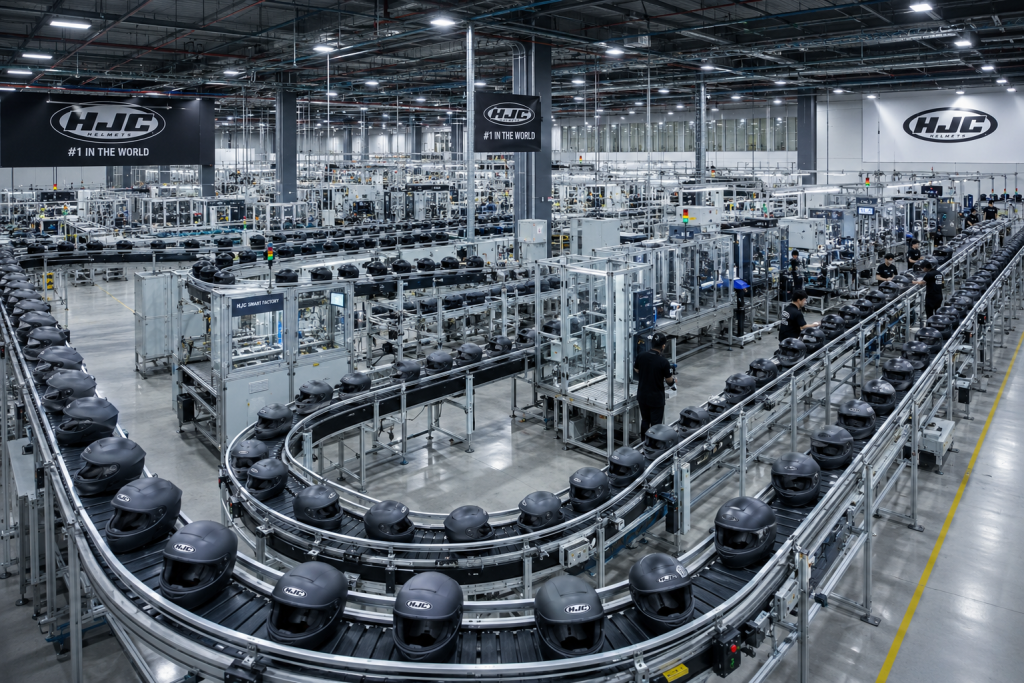
Inside the HJC Factory: How a World-Class Racing Helmet is Made
May
When you hold a flagship helmet like the HJC RPHA 1 in your hands, it feels like a singular, seamless object—a lightweight, aerodynamic shell with a finish as smooth as a glass mirror. To the casual observer, it is simply a combination of plastic, foam, and fabric. However, behind that finished product lies one of the most complex and disciplined manufacturing sequences in the world of high-end sports equipment.
Creating a helmet capable of protecting a human brain at MotoGP velocities is a feat of advanced chemistry, structural physics, and meticulous craftsmanship. At HJC’s state-of-the-art manufacturing facilities in South Korea and Vietnam, raw carbon fibers and liquid resins are transformed through a multi-stage industrial “sprint” into a life-saving fortress.
In this article, we are taking you behind the security gates of the HJC factory. We will dissect the technical journey of a racing helmet, from the initial weaving of the P.I.M. Plus matrix to the final, hand-applied graphic decals and the brutal high-velocity testing that ensures every shell is ready for the world stage.
1. The Fiber Matrix: Weaving the “P.I.M. Plus” Foundation
The birth of an HJC racing helmet does not begin with a mold; it begins with a loom. Unlike entry-level helmets that use injected polycarbonate (plastic), premium RPHA series helmets utilize Premium Integrated Matrix (P.I.M.) Plus technology.
In the first stage of production, workers handle massive rolls of high-tech technical fabrics. These aren’t standard textiles; they are sheets of high-modulus carbon fiber, aramid (Kevlar), and specialized organic fiberglass.
The Recipe of Strength
Each shell size has a specific “pattern” of fabric pieces. Technicians carefully cut these sheets into precise shapes, which are then layered by hand into a clean, pre-prepared steel mold. The layering is not random; it is a mathematically optimized sequence designed to ensure the shell remains rigid in some areas (to prevent punctures) while remaining slightly flexible in others (to absorb energy). By combining these four distinct materials, HJC achieves a strength-to-weight ratio that traditional materials simply cannot match.
2. The Pressure Cooker: Molding and Resin Injection
Once the layers of dry carbon and aramid are placed inside the steel mold, the process enters its most high-tech phase. To transform these soft fabrics into a rock-hard composite shell, they must be bonded together with an aerospace-grade epoxy resin.
Controlled Thermal Bonding
HJC utilizes a specialized heated molding process. The steel mold is closed, and the liquid resin is injected under high pressure. Simultaneously, a vacuum is created inside the mold to ensure the resin penetrates every single microscopic gap between the fiber weaves.
The mold is then heated to a specific temperature, “curing” the resin and turning the multi-layered fabric into a singular, inseparable composite shell. This process is monitored by computers to ensure zero air bubbles or resin “pooling.” Excess resin adds weight without adding strength, so HJC’s goal is to use the absolute minimum amount of resin required to saturate the fibers—a precision task that defines the lightness of the RPHA series.
3. Robotic Surgery: Laser Cutting and Eyeport Preparation
When the shell emerges from the mold, it looks like a rough, unfinished “egg.” It has excess material around the edges and no openings for the visor or the ventilation ports.
To turn this rough shell into a functional helmet, HJC utilizes 5-axis robotic laser cutters. These high-powered lasers are programmed with sub-millimeter precision. As the shell rotates on a robotic arm, the laser slices through the thick composite matrix to create:
The panoramic eyeport for the visor.
The intake and exhaust ports for the ACS ventilation system.
The bottom rim of the helmet.
Using lasers instead of mechanical saws ensures that the edges are perfectly smooth and that the structural integrity of the fiber weaves is never compromised by the vibrations of a traditional blade.
4. The Protective Heart: Multi-Density EPS Integration
While the outer shell provides the “armor,” the internal Expanded Polystyrene (EPS) liner provides the “brakes.” The EPS is the white or black foam layer that actually saves your life during an impact.
The Engineering of Energy
HJC’s EPS liners are not a single block of foam. They are “multi-density” structures. In the factory, different beads of polystyrene are injected into molds at varying pressures. This creates a liner that is:
High-Density in the crown and sides to handle high-velocity impacts.
Low-Density in other areas to absorb softer, slower impacts that could still cause concussions.
The kinetic energy of an impact is calculated by the formula:
To neutralize this energy, the EPS must collapse in a controlled manner. HJC engineers design internal air channels directly into the EPS during this molding stage, ensuring that the ACS ventilation system has a clear “highway” to move air over the rider’s scalp.
5. The Art of the Graphic: Hand-Applied Precision
Perhaps the most surprising part of the HJC factory is how much of the final look is done by hand. Once the shells are sanded and primed in a dust-free “clean room,” they are ready for their graphics—whether it’s a solid matte black or the complex “El Diablo” replica for Fabio Quartararo.
The Water-Slide Decal Process
Applying complex racing graphics to a curved, 3D surface like a helmet is a task that even the most advanced robots struggle with. Instead, HJC employs highly skilled technicians who apply water-slide decals manually. Each color and graphic element is carefully positioned and smoothed out to remove air bubbles.
Once the graphics are set, the helmet receives multiple layers of high-quality UV-resistant clear coat. This clear coat protects the graphics from fading in the sun and gives the helmet its signature high-gloss shine.
6. The Final Audit: Quality Control and the Crash Lab
Before a helmet is boxed and shipped, it must pass a final, unforgiving “Quality Audit.” HJC doesn’t just check for paint flaws; they check for life-saving reliability.
The In-House Test Lab
HJC maintains their own rigorous testing laboratories within the factory grounds. From every production batch, random helmets are pulled and subjected to:
The Drop Test: Dropping the helmet from various heights onto steel anvils to measure G-force transfer.
The Penetration Test: Dropping a weighted striker onto the shell to ensure it cannot be punctured.
The Retention Test: Pulling on the chin strap with hundreds of pounds of force to ensure it never snaps.
The Wind Tunnel: Placing the helmet in HJC’s proprietary wind tunnel to verify that aerodynamic lift and wind noise remain within factory specifications.
Summary Table: The Lifecycle of an HJC Racing Helmet
| Stage | Process | Key Technology |
| 1. Preparation | Hand-layering technical fabrics. | P.I.M. Plus (Carbon/Aramid/Glass) |
| 2. Molding | High-pressure resin injection. | Vacuum-Assisted Resin Transfer |
| 3. Precision | Cutting ports and eyeports. | 5-Axis Robotic Laser Cutting |
| 4. Interior | Molding the foam energy absorber. | Multi-Density EPS Engineering |
| 5. Finishing | Applying decals and clear coat. | Manual Water-Slide Application |
| 6. Validation | Destruction and aero testing. | In-House Crash Lab & Wind Tunnel |
Final Verdict
The HJC factory is a place where industrial robotics and human artistry coexist. It takes over 100 individual steps and dozens of highly trained specialists to create a single RPHA racing helmet. By maintaining total control over every stage—from the first carbon weave to the final clear coat—HJC ensures that “quality” isn’t just a marketing word, but a structural reality. When you click your HJC visor shut, you aren’t just wearing a plastic shell; you are wearing a masterpiece of high-speed engineering designed to protect your most valuable asset.
