
In-Depth Reviews & Product Comparisons, Post
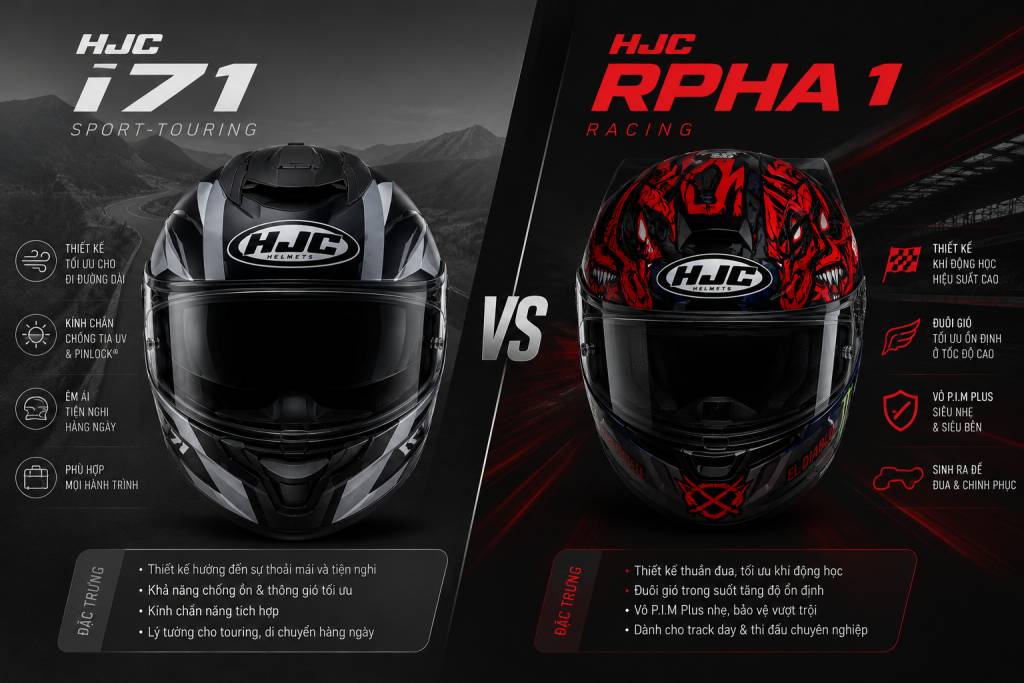
HJC i71 vs. HJC RPHA 1: Which Full-Face Helmet Fits Your Riding Style Best?
May
When it comes to choosing a high-quality motorcycle helmet, the market offers an overwhelming number of options. However, experienced riders know that selecting the right headgear is not just about choosing a reputable brand or a cool graphic design—it is about matching the helmet’s specific engineering to your personal riding environment and motorcycle type. HJC, a global leader in helmet manufacturing, currently offers two standout models that represent completely different engineering philosophies: the HJC i71 and the HJC RPHA 1.
While both are exceptional full-face helmets crafted with meticulous attention to detail, they are designed for entirely separate groups of motorcyclists. The i71 is built as a highly practical, feature-rich sport-touring gear, whereas the RPHA 1 is a compromise-free, track-focused racing weapon engineered directly for MotoGP and WorldSBK competitive circuits. In this comprehensive comparison, we will break down the structural, functional, and ergonomic differences between these two titans to help you determine which helmet perfectly aligns with your specific riding style.
1. Shell Composition, Structural Weight, and Safety Certifications
The most profound difference between the HJC i71 and the RPHA 1 begins at the foundational level with their outer shell materials and the safety standards they are designed to satisfy.
HJC i71: The Polycarbonate Street Defender
The HJC i71 utilizes an Advanced Polycarbonate Composite Shell. Polycarbonate is highly regarded in the motorcycle industry for its excellent impact-absorption capabilities and exceptional cost-efficiency. Designed using advanced Computer-Aided Design (CAD) technology, the i71 shell is optimized for an ergonomic and compact fit.
In terms of safety, the i71 is fully certified under the latest European ECE R22.06 standard alongside local Quatest QCVN certifications. The ECE 22.06 protocol is highly rigorous, testing for rotational forces and oblique impacts. While the polycarbonate construction provides elite street-level protection, it is inherently heavier than high-end composites, causing the i71 to tip the scales at a slightly higher weight profile.
HJC RPHA 1: The Race-Bred Fortress
In stark contrast, the HJC RPHA 1 is constructed from HJC’s flagship P.I.M. Plus (Premium Integrated Matrix Plus) shell architecture. This elite composite blend layers carbon fiber, carbon-glass hybrid fibers, and aramid fibers in a proprietary matrix. This complex weave delivers structural rigidity and energy dissipation properties that far surpass standard polycarbonate, allowing the shell to be incredibly thin and lightweight while offering superior structural integrity.
More importantly, the RPHA 1 satisfies the absolute pinnacle of head protection: official FIM Homologation (FRHPhe-01). This certification is strictly mandatory for professional racing leagues like MotoGP. FIM testing involves extreme velocity impacts and strict penetration evaluations designed to simulate high-speed track crashes. If your riding style demands maximum structural protection and minimum physical weight to reduce neck fatigue at triple-digit speeds, the RPHA 1 is the undisputed winner.
2. Aerodynamics, Stability, and Riding Posture Optimization
A helmet’s external aerodynamic profile dictates how comfortable you will remain after hours of continuous riding, but the effectiveness of that profile depends heavily on your motorcycle’s ergonomics.
The Upright Touring Stance of the i71
The HJC i71 is structurally optimized for a neutral, upright, or slightly forward-leaning riding posture. This setup is typical of sport-touring bikes, naked streetfighters, cruisers, and adventure motorcycles. The airflow channels and surface contours of the i71 are engineered to slice through the wind cleanly when your head is held at a natural angle. It minimizes wind buffeting and prevents aerodynamic lift under normal highway conditions, ensuring a relaxed, quiet, and stable ride during cross-country tours or daily city commutes.
The Aggressive Race Tuck of the RPHA 1
The RPHA 1, however, is designed with a singular focus: high-speed track performance in a full racing tuck position. When a sportbike rider tucks tightly behind the windscreen on a fast straightaway, standard helmets experience massive drag and instability. The RPHA 1 features an aggressive, teardrop-shaped profile with sharp rear gables.
Furthermore, the box includes a massive, transparent extended aerodynamic spoiler that clips onto the rear of the helmet. This spoiler extends the aerodynamic footprint, smoothing out the low-pressure air wake coming off the rider’s leather suit. This completely eliminates high-speed helmet shaking and aerodynamic lift at extreme velocities, allowing track-day enthusiasts and sportbike owners to maintain absolute visual focus.
3. Optical Systems: Convenience vs. High-Velocity Track Requirements
How a helmet handles vision and shifting light conditions is another clear indicator of its intended target audience.
+------------------------------------+------------------------------------+
| Feature                            | HJC i71 (Sport-Touring)            | HJC RPHA 1 (Racing)                |
+------------------------------------+------------------------------------+
| Clear Face Shield Model            | HJ-38 (Wide view, center lock)     | HJ-35 (Panoramic, dual racing lock)|
| Internal Drop-Down Sun Visor       | Yes (HJ-V12 with 3-step adjustment)| No (Omitted for safety and weight) |
| Tear-Off Post Compatibility        | No                                 | Yes (Standard for track racing)    |
| Pinlock Anti-Fog Insert            | Included                           | Included                           |
+------------------------------------+------------------------------------+
i71: The Master of Convenience
The HJC i71 is a masterclass in optical convenience. It features the HJ-38 clear face shield, equipped with a secure push-and-hold center latch mechanism that keeps the visor locked tight against the weather seals. Its defining touring feature is the integrated HJ-V12 internal drop-down sun visor.
Operated via a sleek slider on the left rim, this dark-smoke inner shield features an innovative 3-position depth adjustment mechanism. Riders can customize exactly how far the sun shield drops down to accommodate their facial anatomy perfectly. This setup eliminates the need to carry a secondary tinted visor or wear sunglasses, making it incredibly adaptive to changing weather conditions throughout a long day of touring.
RPHA 1: Pure Optical Focus
The RPHA 1 completely omits the internal sun visor. Incorporating an internal drop-down shield requires creating a hollow cavity in the forehead section of the EPS liner, which slightly reduces the helmet’s localized impact-absorption capabilities—a compromise HJC refuses to make on a dedicated race lid.
Instead, the RPHA 1 utilizes the race-grade HJ-35 panoramic shield. This shield provides an expanded horizontal and vertical field of view, critical for tracking apexes when leaning deep into a corner. The HJ-35 features heavy-duty mechanical dual-locking latches to prevent the shield from bursting open during a high-speed slide, and it comes standard with built-in tear-off posts, allowing track riders to quickly snap away plastic films to clear debris mid-race.
4. Micro-Climate Management, Interior Liners, and Daily Comfort
Both helmets utilize HJC’s highly advanced ACS (Advanced Channeling Ventilation System), which uses deep grooves molded into the internal EPS liner to pull cool air from the front intake vents and exhaust hot, humid air out the rear ports. However, the internal execution differs based on comfort priorities.
The i71 balances ventilation with sound dampening and plush, all-day ergonomics. Its interior features high-performance, moisture-wicking Silvercool anti-bacterial fabric. The 3D-molded cheek pads and crown lining are designed to provide a comfortable, accommodating fit from the moment you put it on. Additionally, the i71 features deep, integrated structural speaker pockets specifically engineered to house the Smart HJC 21B and 50B Bluetooth communication systems, keeping the intercom unit aerodynamically recessed into the shell.
The RPHA 1 prioritizes maximum high-flow air volume and an unyielding, ultra-secure fitment. The padding is exceptionally firm, clamping tightly around the rider’s jawline and skull to ensure the helmet cannot shift or lift under immense wind pressure at track speeds. The interior is lined with a premium quick-drying material, and the cheek pads feature an integrated Emergency Quick Release System (EQRS). This system allows emergency track workers to instantly remove the cheek padding by pulling two integrated red tabs, allowing them to gently slip the helmet off without straining the rider’s neck after an accident.
5. Final Verdict: Matching the Helmet to Your True Riding Style
To summarize the decision-making process, your choice between these two premium HJC offerings should come down to your primary motorcycle type and your typical riding environment:
Choose the HJC i71 if:
You primarily ride a sport-touring bike, naked bike, adventure motorcycle, or a daily commuter.
You frequently ride long distances and encounter changing light conditions where an internal drop-down sun visor is essential.
You prioritize long-distance plush comfort, integrated Bluetooth communication systems, and a quick-release Micro Buckle chin strap.
You want premium ECE 22.06 certified protection at a highly accessible, mid-tier price point.
Choose the HJC RPHA 1 if:
You ride a high-performance sportbike, frequently participate in track days, or actively engage in competitive motorcycle racing.
You demand the absolute maximum level of protection available, backed by the prestigious FIM safety homologation.
You require absolute aerodynamic stability at high velocities, complete with an extended rear aero spoiler.
You prefer the lightweight feel of a premium composite matrix shell and a track-mandatory Double D-Ring closure system.
