
Rider Guides & Expert Maintenance Tips, Post
Quick Fixes for a Smelly Helmet: How to Deodorize Your Gear After a Rainy Ride
May
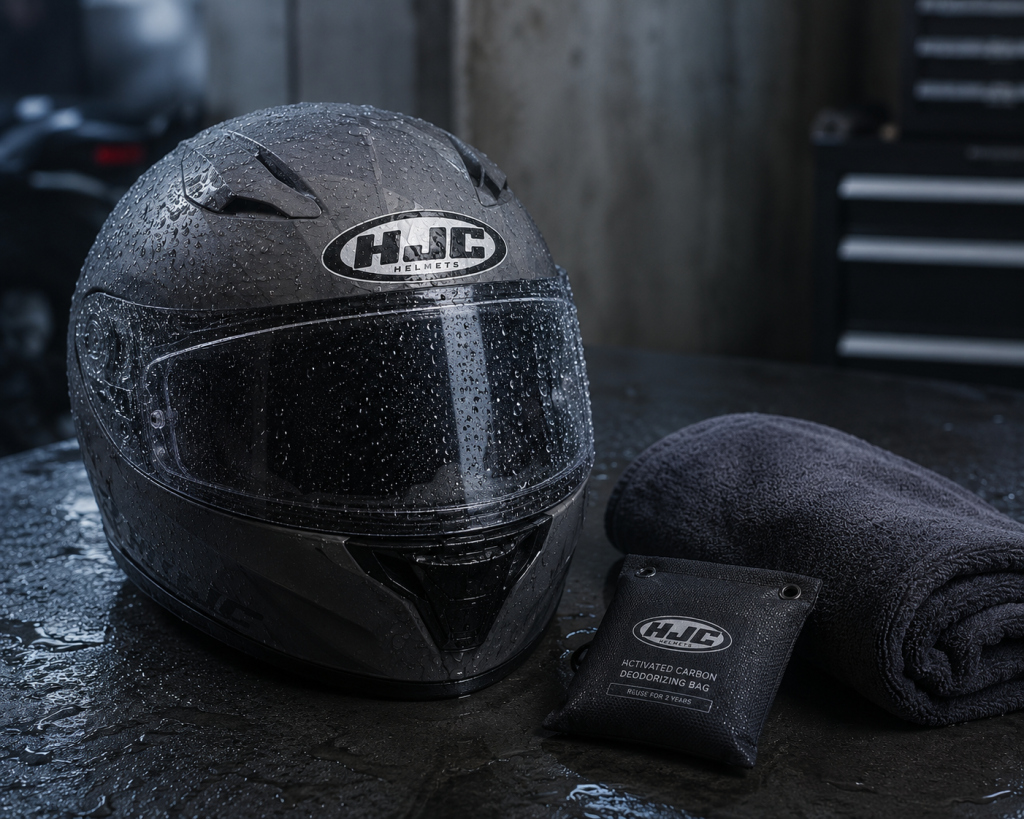
HJC We’ve all been there. You’re enjoying a perfect ride when the clouds turn a bruised purple, and within minutes, you’re caught in a torrential downpour. You make it home, peel off your soggy gear, and toss your dripping helmet onto the shelf, thinking, “I’ll deal with it tomorrow.”
Fast forward 24 hours: you pick up your HJC, and the smell that hits you is a biological tragedy. It’s a mix of wet dog, stagnant pond water, and old gym socks.
When your helmet’s interior gets soaked, the moisture trapped within the dense 3D foam becomes a high-speed breeding ground for bacteria. If you don’t act fast, that “swamp smell” becomes a permanent resident in your Silvercool or Supercool lining. But don’t worry—you don’t always need to perform a full 48-hour deep wash to save your gear.
In this guide, we’ll explore the tactical “quick fixes” to deodorize your helmet after a rain ride, from the 30-minute extraction rule to the secret of activated charcoal.
1. The 30-Minute Golden Window: Extraction First
The biggest mistake riders make after a rainy ride is letting the helmet air-dry naturally while it’s still saturated with water. Moisture itself doesn’t smell; it’s the prolonged dampness that allows bacteria to feast on the organic residues (sweat and skin oils) inside your padding.
The “Towel Wick” Method
The moment you walk through the door, take a clean, dry cotton towel. Reach inside the helmet and press the towel firmly into the cheek pads and the crown liner. Your goal is to physically “wick” as much liquid water out of the foam as possible.
Why it works: By removing 80% of the liquid water in the first 30 minutes, you drastically shorten the drying time, effectively “starving” the bacteria of the humid environment they need to multiply.
2. Airflow is King: The “Fan Torture” Technique
Never, ever leave a wet helmet in a closed closet, a gear bag, or the trunk of your scooter. Stagnant air is the enemy of hygiene.
The Setup
Place your helmet on a dedicated helmet stand or a large roll of paper towels (to keep the bottom open). Position a standard household electric fan so it blows a continuous stream of cool air directly into the eyeport.
The Pro Move: If you have an HJC with a removable chin curtain, take it off to maximize the exhaust path.
Avoid Heat: It’s tempting to use a hairdryer or put the helmet near a heater to speed things up. Don’t. Extreme heat can melt the adhesives holding your EPS liner in place and warp the plastic baseplates of your visor. Cool, moving air is all you need.
3. The Quick-Fix Deodorizer: Vodka or Professional Sprays?
If the smell has already started to creep in, you need a neutralizing agent. You have two highly effective paths:
Path A: The “Biker’s Secret” (Cheap & Effective)
Mix a solution of 70% Isopropyl alcohol (or cheap, unflavored Vodka) and distilled water in a 1:1 ratio. Lightly mist the interior padding.
The Science: Alcohol is a powerful antimicrobial. It kills the bacteria on contact and evaporates almost instantly, taking the odor molecules with it.
Caution: Do not saturate the helmet. A light misting is enough. Excessive alcohol can eventually dry out the synthetic fibers of your liner.
Path B: Specialized Enzyme Sprays
Products like Motorex Helmet Care or Muc-Off Foam Fresh use active enzymes to “eat” the organic matter causing the smell.
The “Wildcard” Rule: If you’re in a pinch and don’t have gear-specific spray, a light misting of unscented fabric refresher (like Febreze) works, but ensure it is the antibacterial version. Avoid heavy floral scents, as they often just mix with the funk to create a “perfumed swamp” smell.
4. Nature’s Vacuum: The Activated Charcoal Hack
If you’ve dried the helmet but a faint, musty scent remains, you need an adsorbent.
The Bamboo Charcoal Bag
Go to a local hardware or home store and buy a small pouch of activated bamboo charcoal. After your helmet is dry, tuck the pouch inside the chin bar and close the visor.
Why it works: Activated charcoal is incredibly porous at a microscopic level. It acts like a silent vacuum, pulling residual odor molecules out of the air and trapping them inside the charcoal matrix. Leave it overnight, and by morning, the interior should smell completely neutral.
5. Summary Table: The “Rainy Day” Deodorizing Protocol
| Phase | Action | Tool Needed |
| Minute 0-15 | Physically extract liquid water. | Dry Cotton Towel |
| Minute 15-60 | Neutralize initial bacterial growth. | 50/50 Alcohol Mist |
| Hour 1-6 | Forced evaporation. | Electric Fan (Cool Air) |
| Overnight | Deep odor adsorption. | Activated Charcoal Bag |
6. Prevention: Keeping the “Silvercool” Active
Modern HJC helmets use Silvercool technology, which uses silver ions to prevent bacteria from growing. However, even silver ions can’t keep up with a helmet that is left soaking wet for three days.
The “Liner Swap” Strategy: If you live in a high-rainfall area (like Da Nang during monsoon season), consider buying a second set of cheek pads. They are relatively inexpensive. This allows you to pull the wet ones out for a proper wash and dry, while you snap in a fresh, dry set for the next morning’s commute.
Final Verdict
A rainy ride doesn’t have to result in a smelly helmet. By focusing on speedy extraction and continuous airflow, you can keep your HJC’s interior as fresh as the day you unboxed it. Remember: the nose knows. If your helmet smells “off,” it’s a sign that biology is winning. Use these quick fixes to take back control of your cockpit.
Do you currently have a backup set of cheek pads for your HJC, or do you usually wait for your primary set to dry?
