Brand Heritage & Racing Legacy, Post
HJC’s Iconic Marvel and DC Collaborations: When Safety Meets Superheroes1
May
In the motorcycle industry, helmet graphics have traditionally followed a predictable evolution. For decades, designs were limited to aggressive “speed blocks,” neon racing stripes, or the personal replicas of professional MotoGP riders. While these designs appealed to the hardcore racing community, they often felt disconnected from the broader world of pop culture.
That changed in 2016 when HJC Helmets announced a groundbreaking licensing agreement with Marvel Entertainment, followed closely by a partnership with DC Comics. This wasn’t just a marketing gimmick; it was a cultural shift. By transforming high-performance racing shells into the literal faces of Spider-Man, Iron Man, Batman, and The Joker, HJC tapped into the “inner child” of the global riding community.
In this article, we will explore how HJC revolutionized helmet aesthetics through these iconic collaborations. We’ll analyze the technical difficulty of translating 2D comic book art onto 3D aerodynamic surfaces, highlight the most legendary releases in the series, and explain why these helmets remain some of the most sought-after collector’s items in the motorcycling world.
1. The Marvel Revolution: More Than Just a Logo
When HJC released its first Marvel-themed helmets, they avoided the easy path of simply slapping a logo on the side of a shell. Instead, they pioneered the concept of “Character Skin” graphics. The helmet became the character.
The Spider-Man and Venom Breakthrough
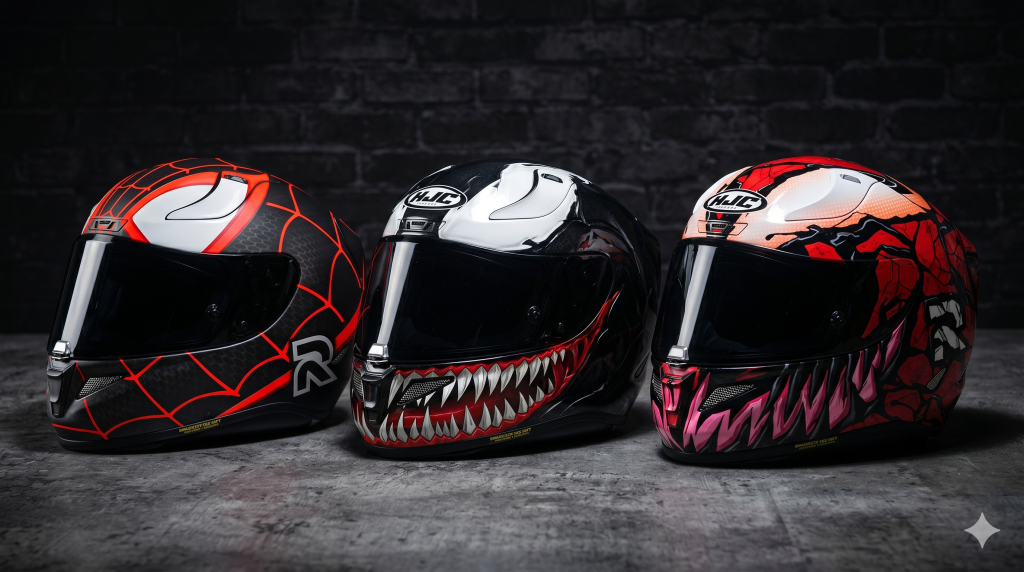
The most iconic releases in the early Marvel era were the Spider-Man and Venom graphics, primarily featured on the flagship RPHA 11 (and now the RPHA 12).
Spider-Man: Instead of a generic red helmet, HJC meticulously recreated the texture of Peter Parker’s suit, complete with raised webbing patterns and the oversized white “eyes” that integrated perfectly with the visor shape.
Venom: This remains arguably the most famous helmet graphic in history. The design utilized the helmet’s vents as part of the character’s anatomy, with the jagged teeth of the symbiote wrapping around the chin bar and a long, slimy tongue trailing back over the crown.
These designs were an instant viral sensation. They proved that a motorcycle helmet could be a piece of wearable art, allowing riders to express their personality and fandom while maintaining top-tier safety.
2. The DC Comics Expansion: Dark Knights and Arch-Nemeses
Following the massive success of the Marvel line, HJC expanded its universe to include the gritty, cinematic world of DC Comics. This collaboration allowed HJC to experiment with darker, more “industrial” aesthetic styles.
Batman: The Dark Knight
The Batman collaboration focused on texture and stealth. Rather than bright colors, HJC utilized matte finishes and carbon fiber weaves to mimic the high-tech armor of the Batsuit. On models like the i71 and RPHA 11, the Batman graphic featured a subtle, “utility-belt” aesthetic and the iconic bat-wing silhouette across the rear spoiler.
The Joker: A Masterpiece of Chaos
If Venom was the king of the Marvel line, The Joker became the crown jewel of the DC collection. Released on the RPHA 11, the Joker graphic captured the character’s haunting, manic energy. The design featured a vibrant purple and green color palette, with the Joker’s signature “Ha Ha Ha” laughter scrawled across the shell and a massive, terrifying grin stretching across the chin bar. It was provocative, aggressive, and perfectly suited for the “anti-hero” persona of many street riders.
3. The Technical Challenge: Wrapping 2D Art on a 3D Surface
Translating a superhero’s face onto a helmet is a geometric nightmare. A helmet is an organic, multi-curved object with various “disruptions” like intake vents, visor hinges, and rear spoilers. If the graphic is misaligned by even two millimeters, the character’s face will look warped or distorted.
The Art of Anamorphic Design
HJC’s graphic designers utilize advanced 3D mapping software to ensure that the character’s features—like Deadpool’s mask or the Flash’s lightning bolts—look correct from every angle.
+-----------------------------------------------------------------------+
| THE CHALLENGES OF SUPERHERO GRAPHIC APPLICATION                       |
+-----------------------------------------------------------------------+
| Symmetry: Ensuring eyes and masks align perfectly across the center.  |
| Vent Integration: Incorporating hốc gió (vents) into the character art.|
| Visor Seamlessness: Designing graphics that "continue" onto the tint. |
| Clear Coat Depth: Protecting complex colors from UV fading.           |
+-----------------------------------------------------------------------+
One of the most impressive feats is how HJC handles the chin bar. Because the chin bar is where a character’s “mouth” or “teeth” usually sit, the engineers must ensure that the ventilation sliders do not break the visual illusion. This requires the manual water-slide decal process we discussed in Article #28, where technicians carefully smooth out the graphic over every complex curve.
4. The “Halo Effect”: Performance Under the Paint
A common skepticism among “serious” riders was that these superhero helmets were “all show and no go.” They worried that HJC was focusing on the paint while neglecting the protection. However, HJC strategically chose to put their most iconic collaborations on their highest-performing shells.
Most Marvel and DC graphics are featured on the RPHA series (11, 12, and now the RPHA 1). This means that underneath the Spider-Man or Batman paint job lies:
P.I.M. Plus Shells: The same carbon-fiber and aramid weave used in MotoGP.
Emergency Quick-Release Cheek Pads: For safety during accidents.
Elite Aerodynamics: Tested in HJC’s in-house wind tunnel.
By pairing world-class safety with world-class pop culture, HJC created a “Halo Effect.” They brought new, younger riders into the brand through the superhero graphics, who then discovered the genuine engineering quality of HJC gear.
5. Summary: The Most Legendary HJC Collaborations
| Character | Helmet Model | Key Visual Feature |
| Venom / Carnage | RPHA 11 / 12 | Jagged teeth and tongue wrapping the chin bar. |
| Iron Man | IS-17 / RPHA 70 | Metallic red/gold finish with “Glowing Eye” visor. |
| The Joker | RPHA 11 | “Ha Ha Ha” typography and manic grin. |
| Batman | i71 / RPHA 11 | Matte black “Tactical Armor” textures. |
| The Punisher | FG-17 / i10 | The iconic skull logo front and center. |
| Superman | RPHA 11 | Bold “S” shield on the crown with blue/red cape flow. |
6. The Collectibility Factor: Helmets as Investments
Because HJC’s licensing agreements are often time-limited, many of these helmets become instant collector’s items. Once a specific graphic (like the original Iron Man or the Ghost Rider replica) is discontinued, its value on the secondary market often skyrockets.
For many riders, owning a Marvel or DC HJC isn’t just about protection; it’s about owning a piece of history. These helmets are frequently displayed in home offices or “man caves” on dedicated stands, serving as conversation pieces even when they aren’t on the road.
Final Verdict
HJC’s Marvel and DC collaborations represent a masterclass in modern brand strategy. By merging the high-stakes world of motorcycle safety with the limitless imagination of comic books, HJC did something few other brands could: they made safety gear “cool” to a mainstream audience. Whether you are a lifelong fan of Peter Parker or you just want a helmet that stands out in a sea of generic black gear, these collaborations offer the perfect fusion of personality and protection. They prove that you can be a serious rider without losing your sense of wonder.
