
Rider Guides & Expert Maintenance Tips, Post
When Should You Replace Your Helmet? How to Check for Signs of EPS Aging
May
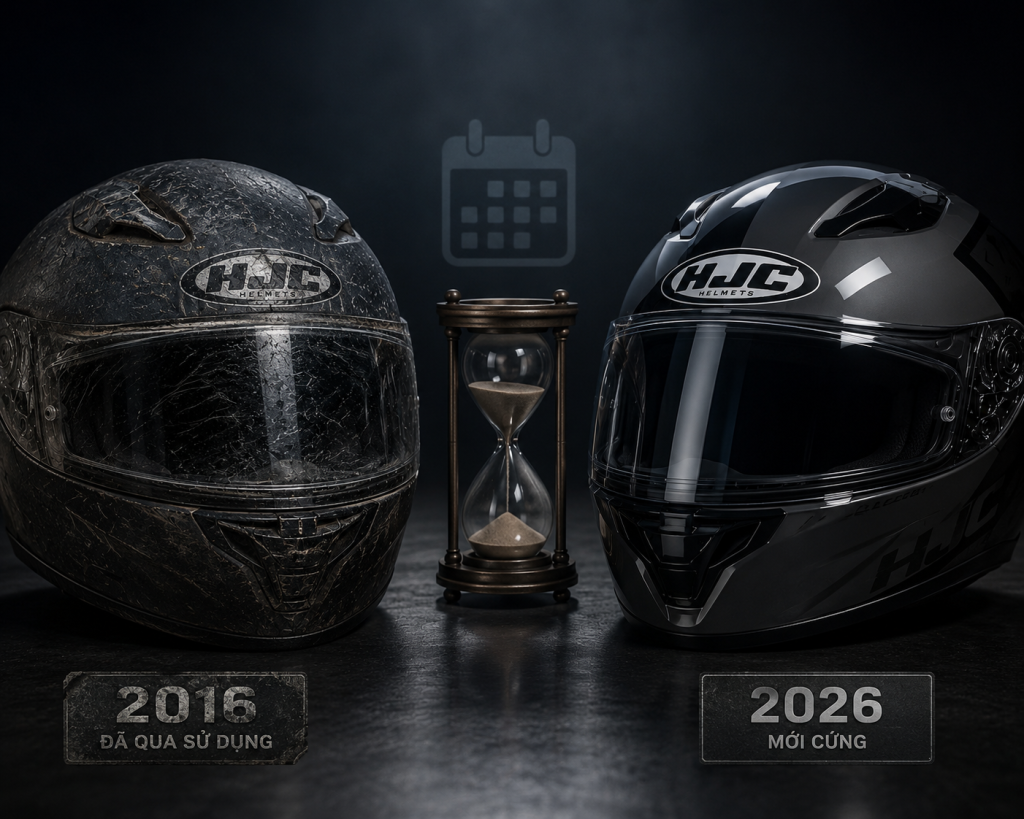
EPS In the world of motorcycling, we often treat our gear as loyal companions. We celebrate the scratches on our boots and the faded patina on our leather jackets as badges of honor from thousands of miles spent on the road. However, when it comes to your helmet, “old and reliable” is a dangerous myth.
A motorcycle helmet is a consumable safety device with a finite lifespan. Unlike your bike’s engine, which can be rebuilt, the internal protective components of your HJC helmet undergo a slow, invisible chemical degradation from the moment they leave the factory. Even if your helmet looks pristine on the outside, the “shocks absorbers” inside may already be past their expiration date.
In this guide, we will break down the science of helmet aging, explain the critical difference between shell integrity and EPS (Expanded Polystyrene) degradation, and provide a technical checklist to help you decide if it’s time to retire your current lid.
1. The Five-Year Rule: Marketing Gimmick or Medical Fact?
Most premium manufacturers, including HJC, recommend replacing your helmet every five years of use, or seven years from the date of manufacture. While this might sound like a sales tactic, it is based on the chemical reality of synthetic materials.
The Role of Atmospheric Exposure
Over five years, a helmet is subjected to a brutal environment. It sits in direct UV sunlight, absorbs acidic rainwater, and is exposed to fuel vapors and exhaust fumes. Internally, it absorbs human sweat, hair oils, and skin acids. These factors don’t just affect the fabric; they slowly leach the plasticizers out of the resin and foam, causing the materials to become brittle. A brittle helmet doesn’t “crush” to absorb energy during a crash—it shatters, transferring the full force of the impact directly to your brain EPS.
2. The Science of EPS Aging: The Invisible Failure
The most important part of your HJC isn’t the shiny outer shell; it’s the thick, white (or black) layer of Expanded Polystyrene (EPS) foam inside. This is the material that actually saves your life by compressing and absorbing kinetic energy during a crash.
How EPS Degrades
EPS is comprised of 98% air trapped within tiny polymer beads. Over time, these beads lose their structural moisture and the air pockets begin to collapse or harden.
The Compression Set: If you wear your helmet daily, the EPS slowly conforms to your head shape. Once the foam has compressed to fit you, that specific area loses its ability to compress again during a crash. This is why a helmet that feels “too loose” is often a sign that the EPS has reached its structural limit.
3. The Physical Inspection Checklist: Signs of Retirement
If you aren’t sure how old your helmet is, you can perform a “Physical Audit.” If your helmet fails even one of these checks, it is no longer a safety device; it is a liability.
Step 1: Check the Production Date
Look under the comfort liner, usually on the chin strap or the EPS itself. You will find a sticker with the Month/Year of manufacture. If that date is more than 7 years ago, the helmet should be replaced regardless of its outward appearance.
Step 2: The EPS “Thumb Test”
Remove the interior lining. Press your thumb firmly into the EPS foam in several places.
Pass: The foam should feel firm but have a very slight, microscopic “give.”
Fail: If the foam feels as hard as a rock (brittle aging) or if it crumbles like dry bread, the polymer has failed. If your thumb leaves a permanent indentation, the foam has lost its elastic memory.
Step 3: Inspect the Shell Integrity
Look for “spider-web” cracks in the paint or deep gouges. While HJC’s P.I.M. Plus shells are incredibly tough, deep scratches can allow moisture and chemicals to seep into the composite matrix, weakening the bond between the fiber layers.
Step 4: The “Liner Flake” Test
If you pull out your cheek pads and see small black or grey flakes falling out, or if the glue holding the vents in place is becoming “gooey,” the adhesives and foams are officially decomposing.
4. The Post-Drop Reality: Is One Drop Enough?
This is the most debated topic in the motorcycle community: “I dropped my helmet on the garage floor—do I need a new one?”
The Verdict
The answer depends on what was inside the helmet.
Empty Drop: If an empty helmet falls from handlebar height (about 1 meter) onto a flat surface, the shell usually handles the energy. Because there was no heavy human head inside to compress the EPS, the helmet is likely still safe.
Loaded Drop: If you drop the helmet while your head is inside (a crash), or if you have heavy objects (like a lock or a heavy camera) stored inside the helmet when it falls, the EPS will compress. EPS does not “spring back.” Once it is crushed, that spot is dead. You must replace the helmet.
5. Summary Table: Replace vs. Keep
| Scenario | Recommendation | Why? |
| 5+ Years of Daily Use | Replace | Chemical degradation from sweat and UV. |
| 7 Years since Manufacture | Replace | Natural structural aging of EPS beads. |
| Visible EPS Cracks | Replace | Total loss of impact absorption. |
| Loose Fit (Wobbling) | Replace | EPS has compressed; no longer protects. |
| Minor Paint Scratch | Keep | Cosmetic only (if shell isn’t gouged). |
| One Crash (Any Speed) | Replace | The helmet has “sacrificed” itself once. |
Final Verdict
Investing in a high-end helmet like the HJC RPHA 12 or the i71 is an investment in your life. However, that investment has an expiration date. Don’t wait for a crash to find out your EPS has turned into brittle plastic. Perform a “Safety Audit” on your gear every season. If you’ve been rocking the same lid since 2020 or 2021, it might be time to browse the 2026 catalog for a fresh shield.
