
Rider Guides & Expert Maintenance Tips, Post
How to Properly Measure Your Head Size When Buying an HJC Helmet Online
May
HJC The digital revolution has completely transformed the way motorcyclists shop for their protective gear. With a few clicks on an e-commerce platform, you gain instant access to an infinite catalog of cutting-edge headgear, allowing you to browse premium race lids like the HJC RPHA 1 or feature-rich sport-touring gear like the HJC i71 right from your couch. Buying online often unlocks better color selection, exclusive graphic variants, and highly competitive pricing.
However, purchasing a motorcycle helmet online introduces a massive psychological hurdle: the anxiety of selecting the wrong size. Unlike a t-shirt or a pair of riding shoes, a helmet cannot simply be worn slightly loose or tight. If a helmet is too small, it will create agonizing pressure hot spots across your forehead and temples, inducing severe headaches and rendering long-distance journeys completely miserable. Conversely, if a helmet is too large, it is a critical safety hazard. A loose helmet will shake violently at highway velocities, lift upward during blind-spot checks, and most dangerously, slip out of optical alignment or fly completely off your head during a high-speed accident.
To eliminate the guesswork and ensure you secure a flawless, factory-perfect fit on your very first order, you must approach the sizing process with mathematical precision. In this comprehensive expert guide, we will break down the underlying physics of helmet fitment, provide a meticulous step-by-step walkthrough to accurately map your cranial dimensions at home, demystify HJC’s specific head-shape geometry, and share the golden rules for verifying your fitment once the box arrives at your doorstep.
1. The Critical Physics of Fitment: Safety and Aerodynamic Dynamics
Before grabbing your measuring tools, it is vital to understand that a motorcycle helmet is not engineered to fit like a casual baseball cap or a plush winter beanie. It is a highly scientific kinetic defense grid. The internal multi-density EPS (Expanded Polystyrene) foam liner is designed to manage extreme impact energy by compressing uniformly under load.
+-----------------------------------------------------------------------+
| THE DANGERS OF AN IMPROPER HELMET FIT                                 |
+-----------------------------------------------------------------------+
| Too Large:   • Rotational slippage during tumbles (Brain shear risk)  |
|              • Wind lifting at highway speeds & severe buffeting      |
|              • Expanded internal air gaps amplify wind noise howling  |
+-----------------------------------------------------------------------+
| Too Small:   • Severe capillary restriction creating localized pain   |
|              • Intense temple/forehead headaches within 20 minutes    |
|              • Difficulty pulling the helmet past ears and jawline    |
+-----------------------------------------------------------------------+
If a helmet shell is too large and a structural gap exists between your skull and the internal padding, the helmet’s protective capabilities are severely compromised. During a crash, your head will travel through that internal gap, accelerating before slamming violently into the EPS liner. This localized impact spike dramatically increases peak G-forces transferred to your brain. Furthermore, a loose-fitting helmet allows dangerous rotational slippage during an oblique slide, turning the helmet into a malicious lever that can twist your neck and cause traumatic brain shear injuries.
From an aerodynamic perspective, a loose helmet is a constant irritation. At highway velocities, oncoming wind resistance will wedge into internal air gaps, causing the helmet to lift upward against your chin strap or buffet violently from side to side. These turbulent air currents generate an intense, high-frequency wind howling noise that causes rapid rider exhaustion. A perfect, snug fit is an absolute requirement to optimize impact energy dissipation and maintain a calm, quiet, and stable cockpit environment.
2. Step-by-Step Guide to Measuring Your Cranial Circumference
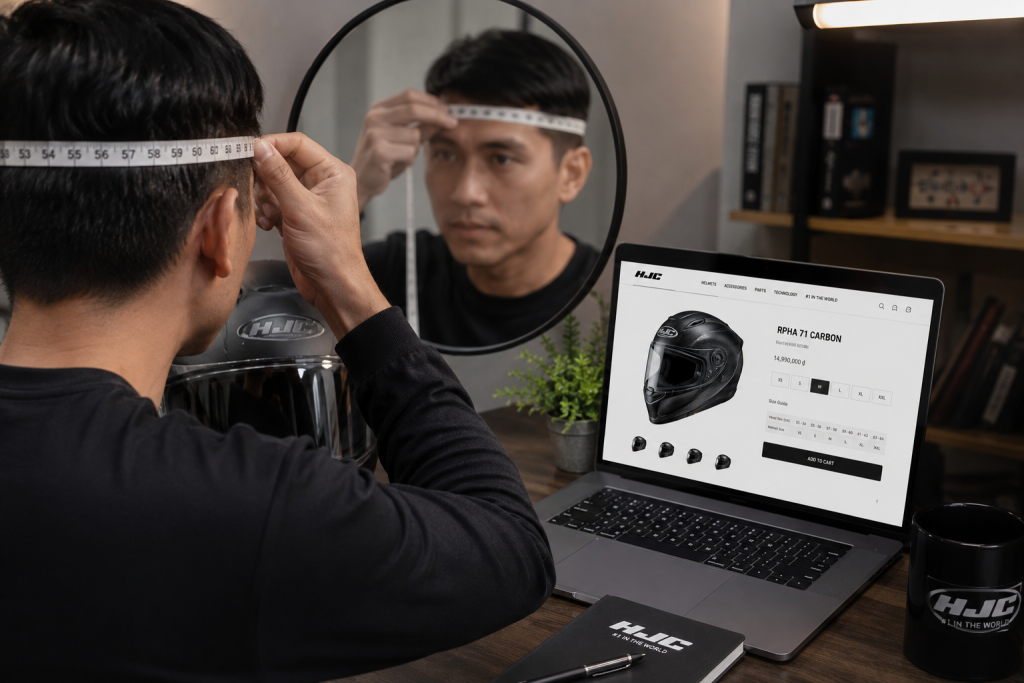
To map your head dimensions with complete accuracy, you will need a flexible, fabric tailoring tape measure. If you do not have one, you can substitute a piece of non-elastic string or twine paired with a standard construction tape measure or a long metric ruler. For the most accurate data, execute this process in front of a mirror or enlist the help of a friend.
Step 1: Identify the Widest Path
The objective is to measure the absolute maximum circumference of your skull. This horizontal plane is dictated by two anatomical landmarks: the ridge directly 1 inch (2.5 cm) above your eyebrows at the front, and the most prominent curve of the occipital bone at the back of your skull.
Step 2: Position the Measuring Tape
Wrap the flexible fabric tape smoothly around your head along this identified horizontal plane. Ensure that the tape sits completely flat against your skin or hair—it must not be twisted, bunched up, or slanted diagonally downward across the gáy (nape of the neck). The tape should wrap snugly around your head, mimicking the uniform clamp of a helmet liner; do not pull it so tight that it pinches your skin, and do not leave it drooping loose.
                   [ 1 Inch / 2.5 cm Above Eyebrows ]
                                  |
                                  v
  (Front) ======================[Tape]====================== (Back)
                                  ^
                                  |
                   [ Widest Part of Occipital Bone ]
Step 3: Record and Repeat Multiple Times
Look directly into the mirror and note the measurement at the intersection point, recording the value down to the nearest millimeter. Do not round up or down to whole numbers. To eliminate potential handling errors, loosen the tape completely and repeat the entire measurement process three separate times. Motorcyclists are often surprised to find their values vary by a full centimeter due to minor tape slants. Take the highest, most consistent metric reading as your official cranial blueprint.
3. Demystifying HJC’s Sizing Ecosystem and Shell Scaling
Once you have recorded your exact head circumference in centimeters, you must map that data against HJC’s official sizing matrix. While sizing boundaries can shift slightly between specialized entry-level lines and elite racing models, HJC maintains an exceptionally structured metric baseline across their modern street catalog.
+--------------------+--------------------+--------------------+
| HJC Sizing Label   | Centimeter Range   | Inches Equivalent  |
+--------------------+--------------------+--------------------+
| Extra Small (XS)   | 54 - 55 cm         | 21.3" - 21.7"      |
| Small (S)          | 55 - 56 cm         | 21.7" - 22.0"      |
| Medium (M)         | 57 - 58 cm         | 22.4" - 22.8"      |
| Large (L)          | 58 - 59 cm         | 22.8" - 23.2"      |
| Extra Large (XL)   | 60 - 61 cm         | 23.6" - 24.0"      |
| Double XL (2XL)    | 62 - 63 cm         | 24.4" - 24.8"      |
+--------------------+--------------------+--------------------+
Understanding Outer Shell Scaling
A critical factor that value-seeking online buyers often overlook is outer shell scaling. Premium manufacturers like HJC do not use a single, massive outer plastic shell for every size and simply pack it with thick or thin foam. Instead, HJC builds up to 3 to 4 distinct physical outer shell sizes across a product line.
For instance, an HJC i71 in size Small uses a physically smaller, lighter, and more compact outer shell than a size Large. If your measurement lands exactly on a sizing boundary (for example, 56.5 cm, sitting directly between a Small and a Medium), you face a strategic choice.
If you prefer an ultra-tight, locked-in racing fitment for track days, choosing the smaller size is ideal, though it will require a longer break-in period. If you are primarily a long-distance touring rider or commuter who wears a thick balaclava, sizing up to the Medium ensures long-distance comfort without restricting blood flow.
4. The Hidden Dimension: Analyzing Head Shapes
Even if you measure your circumference perfectly and match it cleanly to the sizing chart, a helmet can still fit poorly if you fail to account for your unique head shape profile. Human skulls are divided into three distinct profile shapes when viewed from a top-down aerial perspective:
Long Oval: The head is significantly longer from front-to-back than it is wide from ear-to-ear.
Round Oval: The head width from ear-to-ear is nearly equal to its front-to-back length.
Intermediate Oval: The ideal middle ground, where the front-to-back axis is slightly longer than the side-to-side ear measurement.
      [ LONG OVAL ]          [ INTERMEDIATE OVAL ]         [ ROUND OVAL ]
          #####                     #####                     #####
        #       #                 #       #                 #       #
        #       #                 #       #                 #       #
        #       #                 #       #                 #       #
          #####                     #####                     #####
    (Narrow / Long)           (HJC Target Fit)            (Wide / Round)
HJC Helmets engineers the vast majority of their global catalog—including the i71, RPHA 12, C10, and i100—around an Intermediate Oval head shape template. This profile is calculated to fit the vast majority of the riding population beautifully.
However, if you possess a distinctly Round Oval head shape, an Intermediate Oval helmet will feel tight and pinch the sides of your temples, even if the circumference matches the chart. If you possess a Long Oval head shape, an HJC shell may exert a harsh pressure point directly against the center of your forehead, leaving excess, loose space at the sides. Knowing your profile shape allows you to anticipate how the internal 3D padding will interact with your face.
5. The Arrival Test: How to Verify Fitment at Home
When your brand-new HJC helmet arrives, do not immediately rip off the protective visor film, throw away the tags, or jump on your motorcycle for a test ride. Once a helmet is ridden on the road, it collects microscopic dust and road debris, rendering it unreturnable. Instead, conduct these four non-destructive fitment tests inside your living room to guarantee the size is perfect.
Test 1: The “Chipmunk Cheek” Check
Pull the helmet over your head. A brand-new, correctly sized full-face helmet should feel remarkably snug—bordering on tight. The internal 3D ergonomic cheek pads should press firmly against your jawline, pushing your cheeks upward slightly. This is affectionately known as the “chipmunk cheek” effect. If you can slide your mouth open and closed without your teeth touching your inner cheeks, or if the helmet slips on loosely like an old hat, it is too large.
Test 2: The Vertical Roll Test
Secure the chin strap tightly to its proper operational tension. Reach your hands around to the back base of the helmet shell and attempt to push and roll the helmet forward off your head. If the helmet rolls far enough forward to block your vision, or if the rear neck roll slides completely off your occipital bone, the retention fit is loose and unsafe.
Test 3: The Horizontal Shake Test
Grip the chin bar firmly with one hand and shake your head vigorously from side to side. Your skin and facial muscles should move in perfect synchronization with the helmet shell. If the helmet rotates independently, sliding smoothly across your face or bumping against your nose, the interior diameter is too large.
Test 4: The 30-Minute Living Room Endurance Test
If the helmet passes the initial checks, leave it fully strapped on your head while sitting on your couch watching television or browsing your computer for 20 to 30 minutes. A brand-new helmet’s dense polyurethane foam liner requires a brief 5 to 10-hour break-in period to conform to your face.
However, if within 15 minutes you experience a sharp, localized, and throbbing hot spot pain directly against your forehead or temple bones, the shell is structurally too small or matches a conflicting head shape. If your head experiences only a uniform, snug pressure that slowly softens over time, you have officially secured the perfect size.
Final Review Summary: Sizing Best Practices
Pros of Meticulous Sizing
Maximizes Structural Brain Protection: Eliminates internal spatial gaps to optimize kinetic energy dissipation during an impact.
Drastically Lowers Wind Noise: Seals the lower jawline cleanly to eliminate chaotic, high-frequency wind howling.
Ensures High-Speed Stability: Eliminates aerodynamic lifting and helmet shaking at highway velocities.
Unlocks Online Buying Confidence: Saves time and return shipping costs by ensuring a perfect order on the first try.
Cons / Trade-offs
Requires Initial Patience: A perfectly sized new helmet requires a brief, snug break-in period before reaching maximum comfort.
Final Verdict
Mastering the science of cranial measurement is the ultimate tool for any modern motorcyclist looking to utilize the convenience of online e-commerce. By accurately recording your head circumference across multiple consistent tape readings, aligning that data with HJC’s outer shell scaling configurations, and accounting for the brand’s signature Intermediate Oval head profile, you completely dissolve the risks associated with buying online. A motorcycle helmet is far more than a basic fashion statement; it is your ultimate shield against the unpredictable forces of the open road. Investing the time to measure your head correctly guarantees that your new HJC investment remains a comfortable, quiet, and lifesaving asset across every single mile of your journey.
