
Technology & Safety Standards Breakdown, Post
How HJC’s Secure Ratchet Shield System Combines Safety and Daily Convenience
May
When evaluating a high-quality full-face motorcycle helmet, most riders instinctively focus on the outer shell material, the striking graphic artwork, or the plush feel of the interior padding. While these components are undeniably critical for impact protection and comfort, there is another highly complex mechanical assembly that directly dictates your daily riding experience: the face shield ratchet mechanism. Positioned on either side of the helmet eyeport, this small gear-plate assembly bears a massive structural responsibility. It must serve as a secure anchor that keeps the clear visor locked tight against the forces of nature, while remaining smooth and intuitive enough for effortless, tool-less adjustments on the move.
Historically, motorcycle helmet visors relied on basic, friction-based plastic sliders. These primitive designs suffered from severe limitations; over a few months of heavy street use, the plastic tracks would inevitably wear down, causing the visor to loose its tension. At highway speeds, a worn friction shield could suddenly slam shut due on its own, or worse, lift violently upward when checking your blind spot, blinding the rider with a blast of turbulent wind and road dust.
To conquer this engineering flaw, HJC Helmets dedicated extensive research to precision mechanical kinetics, pioneering their award-winning RapidFire Shield Replacement System and advanced secure ratchet architecture.
In this comprehensive technical breakdown, we will dissect the mechanical engineering behind HJC’s ratchet system, analyze how its dual-locking mechanisms maximize high-velocity safety, and explain how this intelligent layout delivers the ultimate balance of track-certified security and daily street convenience.
1. The Mechanical Kinematics of the RapidFire Ratchet System
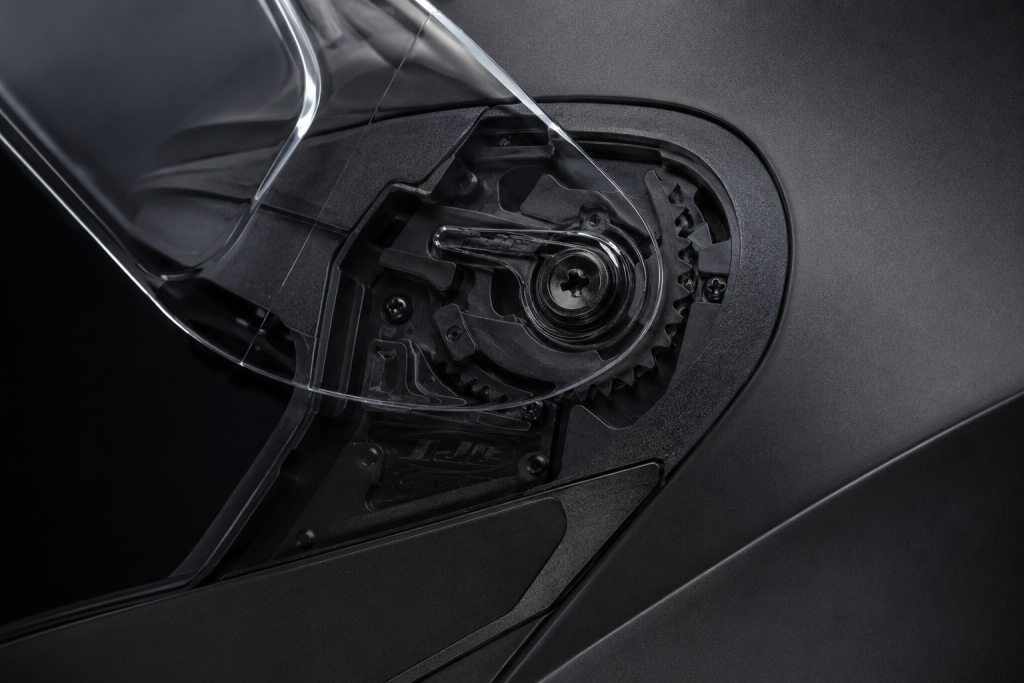
At the absolute core of HJC’s visor technology is the proprietary RapidFire Shield Replacement System. Rather than treating the shield attachment point as a basic pivot peg, HJC’s engineers developed a highly sophisticated, spring-loaded gear plate configuration. The baseplates, which are securely screwed directly into recessed structural pockets within the helmet’s advanced composite shell, utilize an intricate network of interlocking plastic teeth and track guides.
+-----------------------------------------------------------------------+
| HJC RAPIDFIRE RATCHET GEOMETRY                                        |
+-----------------------------------------------------------------------+
| Baseplate Track: Dual-axis movement pulling the visor inward          |
| Interlocking Detents: Heavy-duty plastic teeth establishing steps     |
| Spring Latch Assembly: High-tension coil providing automated locking  |
| Trigger Release Lever: Ergonomic switch for tool-less removal         |
+-----------------------------------------------------------------------+
When you operate an HJC face shield—such as the HJ-38 visor on the i71 or the HJ-35 visor on the RPHA 1—the shield does not simply rotate on a single axis. Instead, the ratchet mechanism utilizes a dual-axis kinematic path.
As you lower the shield toward the fully closed position, the baseplate gear track guides the visor downward, and then, in its final millimeter of travel, pulls the entire shield physically backward against the helmet. This specific mechanical movement forces the visor to compress uniformly against the thick rubber eyeport gasket, establishing a hermetic seal.
The interlocking detents along the track provide crisp, distinct mechanical “clicks” as you open or close the visor. These detents are calibrated with immense structural tension, ensuring that the shield firmly maintains its intermediate open positions (such as a small crack for extra low-speed airflow) without drifting out of place due to the pressure of oncoming highway wind currents.
2. The Dual-Locking Architecture: Track-Certified Security for High-Speed Hazards
At standard urban commuting speeds, wind pressure against a motorcycle visor is relatively minimal. However, once you cross into highway velocities or push triple-digit speeds on a closed racing circuit, the aerodynamic forces acting on the face shield change dramatically.
As wind sweeps over the front of the helmet, it creates a massive localized high-pressure zone directly on the center of the visor. Simultaneously, the fast-moving air passing over the sides of the shell generates a powerful negative-pressure vacuum. This vacuum actively tries to pull the face shield away from the side baseplates. If a rider executes a sudden “head check” to scan for lane changes at 75 mph, the lateral wind blast can catch the edge of an un-locked visor, ripping it completely off its tracks.
To counter this high-risk scenario, modern HJC helmets utilize a robust dual-locking shield architecture. On sport-touring masterclass lines like the HJC i71, this defense is anchored by a rugged central push-and-hold latch mechanism. Located at the absolute bottom center of the HJ-38 visor, this spring-loaded hook snaps locked into a heavy-duty receiver built directly into the chin bar the moment the visor is lowered completely.
Once engaged, the visor is physically chained to the front shell. It cannot be lifted by wind blasts, and it cannot burst open if your helmet contacts the asphalt during a high-speed slide. To open the visor, the rider must make an intentional, focused press on the central release button, ensuring complete security.
On their flagship MotoGP weapon, the HJC RPHA 1, the locking mechanism is elevated even further with an industrial-grade dual-stage racing lock. This configuration utilizes a central latch combined with an extra physical slide-lock toggle. This double-defense design satisfies the absolute strictest FIM safety regulations, guaranteeing that the shield remains completely hermetically sealed even through a violent, multi-impact track crash at 200 mph.
3. Atmospheric Sealing: Defeating Wind Whistling and Rain Ingress
A major complaint among long-distance touring riders who wear lower-tier helmets is the persistent buildup of high-frequency wind noise, commonly known as wind whistling or howling. This acoustic irritation is almost always caused by microscopic gaps between the face shield and the eyeport frame.
When compressed air forces its way through these tiny gaps at high velocity, it creates turbulent air eddies that generate a deafening noise inside the cockpit, causing severe rider fatigue and permanent hearing degradation over long hours in the saddle. Furthermore, during a heavy rainstorm, these same micro-gaps allow water droplets to seep inside, running down the interior of the visor and blinding the rider.
HJC’s secure ratchet system solves this environmental challenge through its automated atmospheric sealing design. Because the baseplates utilize a spring-loaded, pull-back mechanical path, the visor forms a tight, pressurized seal against the perimeter rubber eyeport gasket.
This flexible rubber seal features a dual-lip design that compresses under the mechanical force of the ratchet baseplates. This compression creates an absolute physical barrier that smooths out external airflow, eliminating the chaotic wind turbulence that triggers high-frequency whistling.
Whether you are blasting through a freezing winter rainstorm or cruising down a windy coastal highway, HJC’s ratchet execution guarantees a remarkably quiet, perfectly dry, and highly focused cabin environment.
4. Daily Convenience: The Sub-Five Second Tool-Less Visor Swap
While maximizing structural safety and atmospheric sealing are the primary defensive duties of HJC’s ratchet system, the architecture truly shines by delivering unparalleled daily convenience. Motorcyclists frequently need to swap their face shields to adapt to changing light conditions across a single day of riding. You might start a morning journey using a clear visor, transition to a dark-smoke or mirrored-gold shield to block blinding afternoon glare, and then need to return to the clear visor to ride home safely after dusk.
On legacy helmets, changing a face shield was a miserable, frustrating chore. It often required carrying specialized screwdrivers, removing complex plastic side pods that could easily crack, and wrestling with high-tension springs that risked snapping your fingers. HJC revolutionized this routine by designing the RapidFire system to be completely tool-less and automated.
[Visor Fully Open] --> Pull Release Lever Down
  --> Pivot Hooks Lift Clear of Gear Tracks
    --> Shield Pops Out Instantly
To execute a shield swap on a modern HJC helmet, the process requires only a few seconds of effortless hand motion.
First, raise the clear visor fully to its maximum open position, which perfectly aligns the internal locking tabs with the exit gates of the baseplate.
Next, locate the small, ergonomic trigger release lever positioned clearly on each side baseplate.
Pull the lever downward using a single finger; the internal spring latch retracts instantly, lifting the pivot hooks clear of the gear tracks and popping the visor loose from the helmet with zero resistance.
To install your dark-smoke or mirrored tint replacement shield, simply line up the circular pivot tabs over the baseplate tracks and push downward firmly. The spring-loaded mechanism will automatically snap shut, locking the new visor into the gear tracks with an audible click.
There are no tools to carry, no screws to lose, and absolutely no complicated alignment charts to follow. It is a brilliant feat of everyday mechanical convenience that allows you to adapt your optics at a gas station stop or a traffic light in under five seconds flat.
Final Review Summary: Pros and Cons of HJC’s Ratchet System
Pros
Elite Level Structural Safety: Central and dual-stage locking latches prevent accidental visor opening at extreme velocities.
Hermetic Atmospheric Seal: Dual-axis kinematics pull the visor tight against the eyeport gasket, eliminating wind whistling and rain leakage.
Crisp Micro-Metric Adjustment: Heavy-duty gear detents hold intermediate open positions firmly against intense highway wind currents.
Lightning-Fast Shield Swaps: Tool-less RapidFire trigger mechanism allows for full visor replacement in under five seconds.
Long-Term Tension Retention: Rugged spring-loaded architecture eliminates the wear-and-tear degradation common in cheap friction systems.
Cons
Mechanical Cleanliness Required: Because the baseplate tracks rely on tight tolerances and interlocking plastic teeth, riding through heavy mud, fine sandstorms, or caking road salt can occasionally cause grit to settle inside the gear tracks. This requires periodic rinsing with warm water to maintain a perfectly smooth clicking action.
Final Verdict
The secure ratchet shield system engineered by HJC stands as a masterpiece of functional everyday design. It successfully demonstrates that maximizing high-speed track safety does not mean you have to sacrifice practical daily convenience. By combining a dual-axis pull-back baseplate path with robust central locking latches and the legendary tool-less RapidFire quick-release trigger, HJC has delivered a flawless optical mounting ecosystem. It completely eliminates the frustrations of visor maintenance, ensures an exceptionally quiet and bone-dry cockpit, and guarantees that your primary line of vision remains rock-solid and secure across every single mile of your journey.
