
In-Depth Reviews & Product Comparisons, Post
Built for the Track: Why MotoGP World Champions Trust the Flagship HJC RPHA 1
May
HJC In the high-stakes arena of elite grand prix motorcycle racing, the laws of physics are pushed to their absolute limits. On any given Sunday in MotoGP, elite athletes corner their machines at astonishing 64-degree lean angles and blast down straightaways at speeds exceeding 360 km/h (223 mph). In this hyper-velocity environment, where a fraction of a second separates a podium finish from a high-speed disaster, protective riding gear ceases to be a passive precaution. It becomes an active piece of survival and performance equipment.
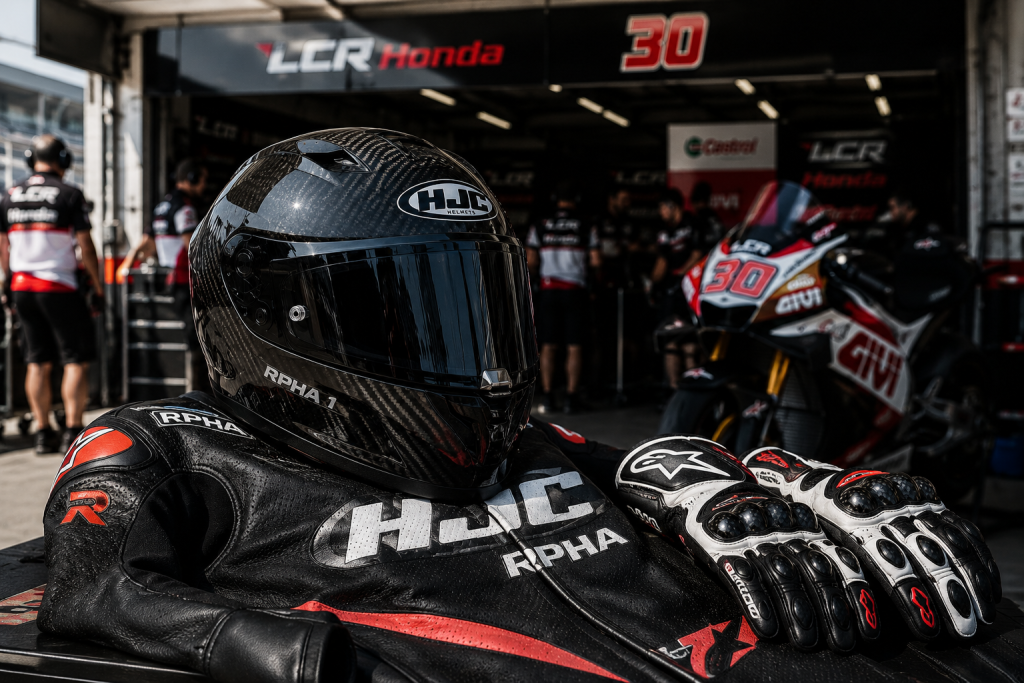
Among all protective assets, the helmet bears the ultimate responsibility of shielding the rider’s most critical organ from massive kinetic energy transfers. Historically, the elite tier of racing headgear was dominated by a select few legacy European manufacturers. However, HJC Helmets disrupted the global racing hierarchy by introducing their undisputed pinnacle racing fortress: the HJC RPHA 1.
Today, top-tier Grand Prix world champions and factory riders trust their lives and careers to this exact shell. Far from a basic commercial product dressed up in fancy race livery, the RPHA 1 represents the absolute peak of modern impact engineering, aerodynamic sculpture, and material science. In this comprehensive technical breakdown, we will examine the engineering secrets behind the HJC RPHA 1 and analyze exactly why MotoGP world champions unconditionally trust this flagship helmet on the fastest race circuits on Earth.
1. The FIM Homologation Barrier: Elite Level Brain Protection
To comprehend the sheer protective superiority of the HJC RPHA 1, one must understand that standard consumer helmet certifications like DOT in North America or ECE R22.06 in Europe are simply baseline entry requirements. MotoGP and WorldSBK competitive paddocks operate under an entirely separate safety matrix established by the International Motorcycling Federation: official FIM Homologation (FRHPhe-01).
+-----------------------------------------------------------------------+
| HIGH-VELOCITY SAFETY CERTIFICATION COMPARISON                         |
+-----------------------------------------------------------------------+
| ECE R22.06 Baseline: Tests linear drops and basic rotational speeds.  |
| FIM FRHPhe-01 Level: Tests extreme velocity oblique angles on a rough  |
|                      anvil to calculate real-world brain shear forces.|
| RPHA 1 Status: Passed 100% of FIM crash protocols across all sizes.    |
+-----------------------------------------------------------------------+
Traditional safety standards evaluate a helmet by dropping it in a straight, linear path against a smooth flat surface. While useful, linear drops fail to simulate genuine track accidents. When a racer crashes at triple-digit speeds, they do not simply drop; they hit the tarmac at an angle, causing the helmet to catch on the asphalt and rotate violently. This sudden rotational acceleration causes the brain to twist inside the skull, leading to severe traumatic brain injuries.
The FIM FRHPhe-01 protocol subjects the helmet shell to brutal oblique (diagonal) impact testing against a highly abrasive, rough anvil surface at extreme velocities. It measures the localized rotational forces transferred to the interior skull matrix with meticulous precision.
HJC engineered the RPHA 1 specifically to clear this ultra-strict obstacle. Every single shell size of the RPHA 1 has cleared these devastating oblique impact evaluations, providing world-class champions with the most advanced structural defense grid ever devised against high-speed brain shear injuries.
2. Advanced P.I.M. Plus Material Matrix: Lightweight Kinetic Defense
Satisfying FIM structural requirements often forces manufacturers to build thick, excessively heavy helmet shells. However, for a professional racer enduring brutal G-forces under heavy braking and cornering over a grueling 45-minute grand prix, a heavy helmet is a liability. Extra weight amplifies neck strain, lowers reflex speed, and induces physical exhaustion.
HJC solved this structural paradox through advanced chemistry and material science, creating their proprietary P.I.M. Plus (Premium Integrated Matrix Plus) shell architecture. This composite matrix relies on a highly sophisticated, multi-layered weave of advanced technical fibers:
High-Modulus Carbon Fiber: Supplies incredible structural tensile strength and rigidity while keeping the overall shell profile remarkably lightweight.
Carbon-Glass Hybrid Fiber: Specifically woven into the matrix to optimize energy absorption and provide superior puncture resistance against sharp debris.
Aramid (Kevlar) & Structural Fiberglass Layers: Introduces specialized external flexibility, allowing the shell to intentionally deform slightly upon initial contact to scatter localized kinetic energy before it penetrates the interior liner.
By layering these distinct technical fibers in a mathematically optimized matrix, HJC created a shell that exhibits unparalleled structural integrity and impact energy dissipation properties. This allows the RPHA 1 to remain incredibly thin and lightweight, minimizing the physical burden on the racer’s neck while delivering uncompromising structural defense capabilities.
3. Wind-Tunnel Mastered Aerodynamics and the Extended Race Spoiler
At velocities clearing 200 mph, oncoming wind resistance behaves less like air and more like a solid physical barrier. At these extreme speeds, aerodynamic instability can cause a helmet to lift violently upward or experience chaotic lateral shaking, known as buffeting. If a racer’s head is vibrating even a millimeter at high speed, their vision blurs, making it impossible to read critical braking markers or manage throttle inputs accurately.
The RPHA 1 features an aggressive, teardrop-shaped shell profile sculpted through extensive testing inside HJC’s state-of-the-art, in-house wind tunnel facility. Every contour, ridge, and curve is engineered to manipulate airflow separation fluidly around the rider’s shoulders.
Manipulating Airflow with the Extended Aero Spoiler
The definitive aerodynamic asset of the RPHA 1 is the massive, transparent Extended Aerodynamic Spoiler included in the box. This specialized race spoiler attaches directly to the rear gables of the helmet.
When a racer tucks tightly behind the motorcycle’s front windscreen on a fast straightaway, the extended spoiler bridges the physical gap between the helmet shell and the aerodynamic hump on their leather race suit. It smooths out the low-pressure air turbulence that naturally forms behind a rider’s head, completely neutralizing aerodynamic lift and high-speed helmet buffeting. The direct result is absolute, rock-solid tracking and motion stability, ensuring a perfectly calm and focused cockpit environment at extreme velocities.
4. Track-Optimized Vision: The Panoramic HJC – 35 Visor System
When navigating a racetrack at a professional level, standard street vision geometry is completely inadequate. In a full racing tuck, with your chest pinned to the fuel tank and your chin resting on the triple clamp, standard street helmets force you to crane your neck painfully upward because the top brow frame of the eyeport blocks your forward view of the track.
The HJC RPHA 1 features a significantly tall and wide eyeport architecture engineered specifically for an aggressive racing posture. It utilizes the premium, race-grade HJ-35 clear face shield, providing an expanded horizontal and vertical field of view. This panoramic view allows racers to track distant corner apexes smoothly while leaned deep into a turn, without their vision being compromised by the upper edge of the helmet frame.
The HJ-35 visor is crafted from optically precise, distortion-free polycarbonate and comes standard with built-in, track-mandatory tear-off posts. This setup allows racers to install multiple layers of thin plastic films before a session, letting them instantly rip away a dirty layer to restore clear visibility mid-race if the visor collects track debris or oil mist.
Furthermore, the shield is secured by a heavy-duty, dual-locking central latch mechanism. When slammed shut, the visor is mechanically locked into the baseplates on both sides, ensuring a hermetic seal that completely eliminates wind noise and guarantees the shield cannot be accidentally ripped open by oncoming wind during a high-speed track slide.
5. Secure Lock-In Ergonomics and the Emergency Kit Defense
Inside the helmet, the RPHA 1 provides a firm, highly supportive internal environment designed to prevent any movement during intense track sessions. Unlike plush touring helmets built for casual comfort, the RPHA 1 uses dense, 3D-contoured cheek pads wrapped in a premium Silvercool anti-bacterial fabric.
This specialized textile features excellent moisture-wicking properties and dries rapidly, systematically preventing the accumulation of sweat-induced odors during intense, high-adrenaline racing conditions. The interior provides an intense, uniform clamp around the rider’s jawline and skull, ensuring that under extreme braking forces or violent side-to-side chicane transitions, the helmet remains perfectly locked in place and optically aligned with the eyes.
The Emergency Quick Release System (EQRS)
For critical trackside medical scenarios, the RPHA 1 integrates the Emergency Quick Release System (EQRS). By pulling two clearly marked red loops at the base of the neck roll, track safety marshals can instantly slide the cheek padding out of the helmet entirely.
This creates immediate negative space inside the shell, allowing medical personnel to gently slide the helmet off the racer’s head without putting structural pressure or stress on a potentially injured cervical spine. Securing this elite racing package is the classic, track-mandatory Double D-Ring fastening system, providing a high-strength, adjustable closure that will never fail under immense structural tension.
Final Review Summary: Pros and Cons
Pros
MotoGP-Level Protection: Official FIM safety homologation provides the highest standard of brain protection available on the consumer market.
Flawless High-Speed Stability: The extended aerodynamic spoiler completely eliminates aerodynamic lift and lateral buffeting at 200+ mph.
Expanded Racing Vision: Taller vertical eyeport geometry allows for perfect visibility in a full racing tuck position.
Premium P.I.M. Plus Shell: Multi-layered carbon composite matrix delivers high structural rigidity with minimal physical weight.
Elite Track Accessories: Standard box includes a premium Pinlock anti-fog insert, racing tear-off films, and the extended aero spoiler.
Cons
Stiff Racing Fitment: The unyielding, ultra-secure cheek pad clamp can feel restrictive for riders used to casual street gear.
No Internal Sun Shield: Lacks a drop-down inner sun visor to preserve maximum structural EPS shell integrity for track racing.
