
Brand Heritage & Racing Legacy, Post
The Future of HJC: Smart Helmets, Sustainable Materials, and the Next 50 Years
May
The Future of HJC: Smart Helmets, Sustainable Materials, and the Next 50 Years
As we cross the threshold into the second half of the 2020s, the motorcycle industry is standing at the precipice of a technological revolution. For over five decades, HJC Helmets has defined itself through mechanical mastery—refining the physics of the composite shell, the thermodynamics of ventilation, and the ergonomics of the interior liner. However, the next fifty years of head protection will not be defined solely by how a helmet handles an impact, but by how it integrates into the digital and ecological ecosystem of the modern world.
The “analog” helmet is evolving into a “smart” node within the Internet of Things (IoT). From integrated Augmented Reality (AR) displays to bio-composite materials that reduce the carbon footprint of manufacturing, HJC is currently pivoting its massive R&D resources toward a future where safety is both intelligent and sustainable.
In this final article of our 30-part series, we will explore the cutting-edge innovations currently brewing in HJC’s laboratories. We will analyze the rise of the “Digital Cockpit,” the shift toward green material science, and how HJC plans to protect the next generation of riders in an increasingly connected world.

1. The Digital Cockpit: Beyond Simple Bluetooth
For years, electronic integration in helmets was limited to external Bluetooth “bricks” used for basic intercom communication. With the launch of the Smart HJC 2nd Generation system, the brand has already begun moving toward a more “built-in” philosophy. However, the future holds far more than just audio.
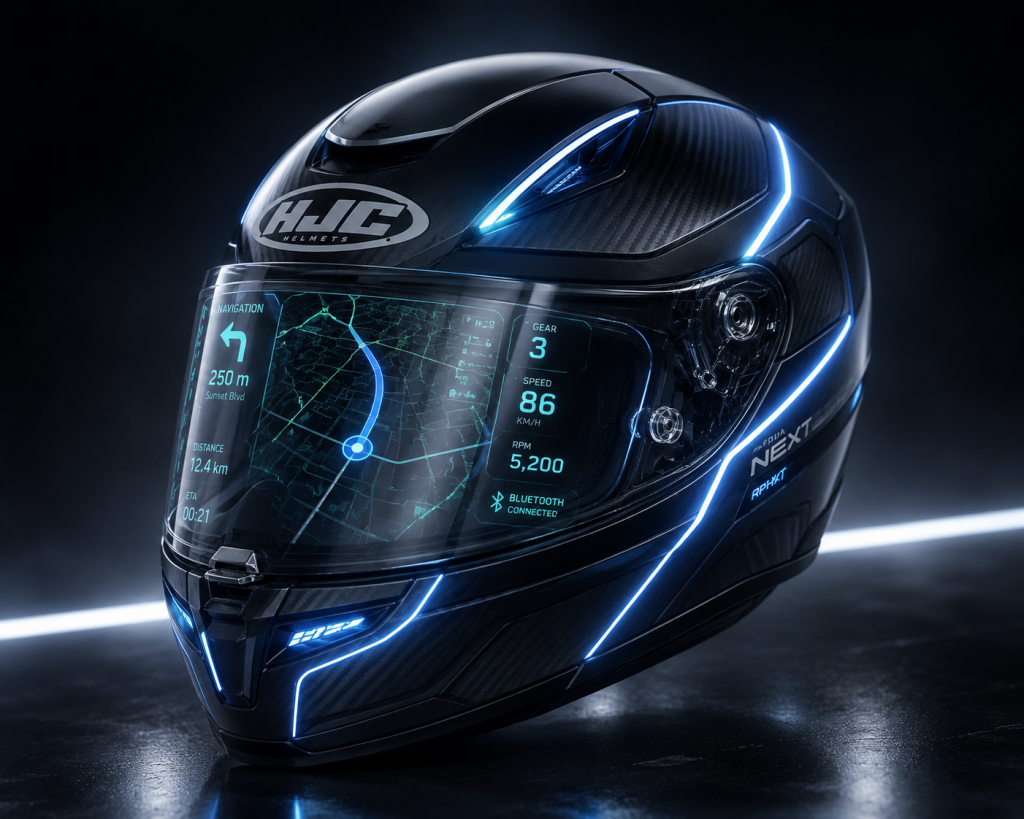
Augmented Reality (AR) and Head-Up Displays (HUD)
HJC is currently exploring the integration of ultra-thin, transparent waveguide displays within the visor architecture.
The Function: Instead of a rider looking down at a phone mounted on the handlebars—a major cause of distracted riding accidents—critical data like GPS navigation, speed, and blind-spot alerts will be projected directly into the rider’s line of sight, focused at infinity.
The Software Logic: These systems will utilize localized AI to filter information, ensuring that only the most critical “emergency” data is shown during high-speed maneuvers, preventing cognitive overload.
Intelligent Sensory Arrays
Future HJC flagship models are expected to feature integrated rear-facing cameras and proximity sensors. These sensors will provide 360-degree situational awareness, vibrating the cheek pads or providing a visual “halo” alert on the HUD if a vehicle approaches too quickly from behind.
2. Material Science 2.0: The Rise of Graphene and Bio-Resins
While the P.I.M. Plus matrix (Carbon, Aramid, Fiberglass) is currently the gold standard, HJC is looking toward the molecular level for the next leap in strength-to-weight ratios.
The Graphene Frontier
Graphene, a single layer of carbon atoms arranged in a hexagonal lattice, is over 200 times stronger than steel and incredibly lightweight. HJC’s future research involves “Graphene-infused” shells. By adding graphene nanoplatelets to the epoxy resin, engineers can create a shell that is significantly thinner and lighter than current carbon fiber models while offering vastly superior puncture resistance and energy dissipation.
Bio-Composites and Sustainability
The traditional helmet manufacturing process is chemically intensive. To address the global demand for sustainability, HJC is experimenting with bio-based resins and natural fiber reinforcements (such as specialized flax weaves).
Recyclable EPS: One of the greatest ecological challenges is the non-biodegradable nature of EPS foam. HJC is investigating “circular” EPS alternatives that can be chemically broken down and recycled into new helmet liners at the end of their five-year lifespan, closing the loop on safety equipment waste.
3. Active Aerodynamics: Helmets that Change Shape
In the current era, a helmet’s aerodynamic profile is “fixed.” A helmet designed for the high-speed tuck of a racetrack often performs poorly in the upright position of an adventure bike. HJC is working to dissolve this compromise through Active Geometry.
Imagine a helmet equipped with micro-actuators that respond to air pressure sensors.
At low city speeds, the vents and spoilers remain retracted for maximum quietness.
As the rider accelerates past 100 km/h, the rear spoilers automatically extend, and the side flaps adjust their angle to neutralize lift and drag based on the rider’s specific head position.
This creates a “liquid” aerodynamic profile that optimizes stability in real-time, effectively using software to manage the fluid dynamics of the wind.
4. The Biometric Guardian: Integrated Health Monitoring
The Future of HJC: Smart Helmets will be more than a shield; it will be a medical monitor. By integrating optical heart-rate sensors and skin-conductance sensors into the Silvercool fabric of the cheek pads, the helmet can monitor the rider’s physiological state.
Fatigue Detection: If the system detects signs of extreme rider fatigue or dehydration (based on heart rate variability and skin temperature), it can trigger an audible alert or a cooling blast from the ventilation system, advising the rider to stop for a break.
Automatic Crash Response (eCall): In the event of a severe impact, sensors can detect if the rider has lost consciousness. Using the paired smartphone’s GPS, the helmet can automatically transmit an emergency “SOS” signal to local first responders, providing the exact coordinates and the severity of the G-forces involved in the crash.
5. Summary Table: The Evolution of the HJC Ecosystem
| Feature | The Analog Era (Past/Present) | The Digital Era (Future) |
| Shell Material | Carbon Fiber / P.I.M. Plus | Graphene-Infused Bio-Composites |
| Navigation | Handlebar-mounted Phone | Integrated AR Head-Up Display |
| Safety | Passive Impact Absorption | Active Proximity & Health Alerts |
| Sustainability | Linear (Landfill at 5 years) | Circular (Recyclable EPS/Resins) |
| Aerodynamics | Static Wind-Tunnel Shapes | Active, Sensor-Driven Geometry |
6. Closing the Loop: A Vision for 2071
As HJC looks toward its centennial in 2071, the brand remains anchored by the same philosophy that started in a small workshop in 1971: Specialization. By refusing to build motorcycles or apparel, HJC remains free to obsess entirely over the singular goal of head protection.
The Future of HJC: Smart Helmets is a world where technology doesn’t distract the rider, but rather “vanishes” into the background, providing a silent, invisible layer of protection. It is a future where a 17-year-old student in a bustling city and a MotoGP racer on a world-class circuit are both protected by the same intelligent, sustainable, and uncompromising engineering.
Final Review Summary: The 30-Article Journey
Over the course of these 30 articles, we have dissected every facet of the HJC universe:
The Products: From the versatile i71 to the racing-pinnacle RPHA 1.
The Physics: The science of ECE R22.06, P.I.M. Plus, and the Venturi effect.
The Ownership: How to measure, clean, and maintain your investment.
The Legacy: The stories of Fabio Quartararo, Marvel, and 55 years of history.
Final Verdict
The journey of The Future of HJC: Smart Helmets is a testament to what is possible when human ingenuity is focused on a noble cause. Whether it is through the mechanical perfection of their current RPHA series or the digital intelligence of their future AR-integrated shells, HJC continues to prove that the most important part of any motorcycle is the person riding it. As you click your visor shut today, you are part of a legacy of safety that is only getting smarter, lighter, and more resilient. The road ahead is long, but with the right shield, you are ready for every mile.
